When you take a generic pill, you expect it to work just like the brand-name version. But what if that pill also contains a hidden carcinogen? That’s exactly what happened with nitrosamine contamination in generic medications - a problem that started in 2018 and is still unfolding today. This isn’t a theoretical risk. It’s a real, documented crisis that has forced recalls, shut down production lines, and changed how regulators and manufacturers think about drug safety.
How Nitrosamines Sneaked Into Medicines
Nitrosamines aren’t added on purpose. They form accidentally during manufacturing. The chemical reaction happens when nitrites - often from excipients like magnesium stearate or water - react with amines already present in the active drug ingredient. This isn’t rare chemistry. It’s a simple, predictable reaction that many manufacturers didn’t test for until it was too late.
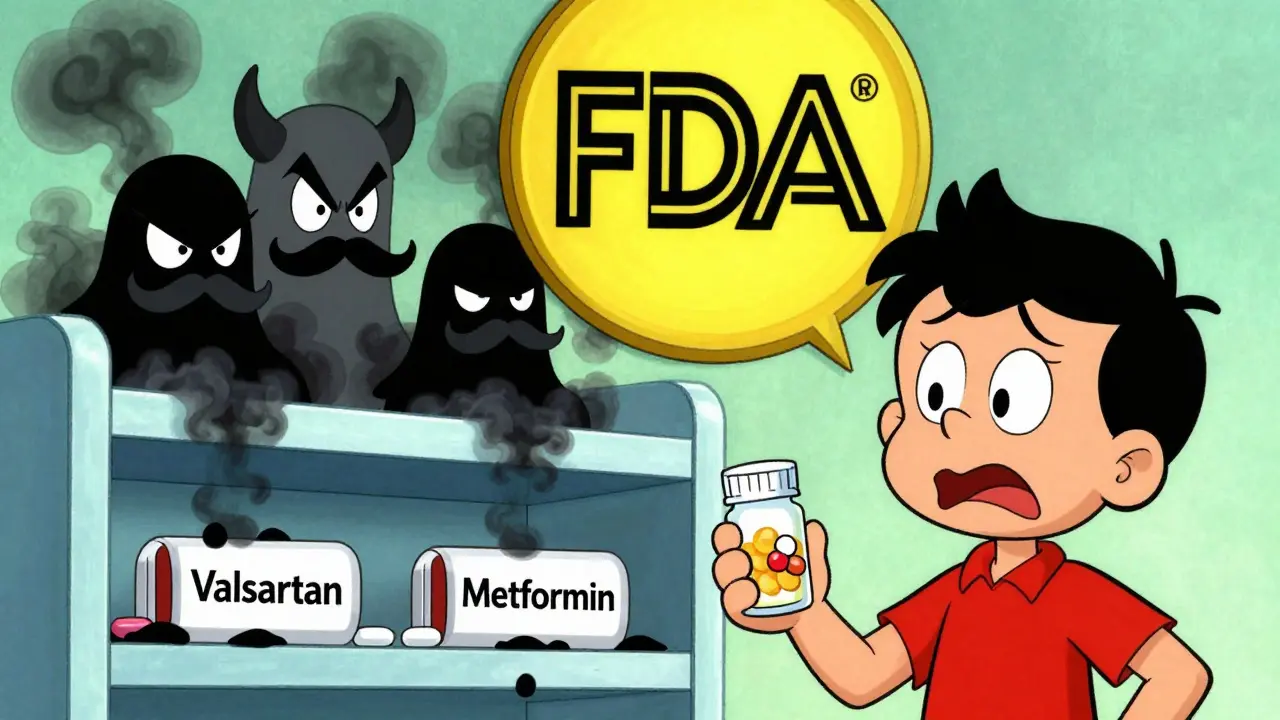
The first major wake-up call came in 2018, when the FDA found N-nitrosodimethylamine (NDMA) in valsartan, a common blood pressure medication. That single discovery led to the sudden withdrawal of 10 products from the U.S. market. Within months, similar contamination was found in losartan, irbesartan, and other ARBs. Then came ranitidine (Zantac), metformin, duloxetine, varenicline - and dozens more. By mid-2025, the FDA had overseen over 40 specific drug recalls directly tied to nitrosamines, with more than 500 total recalls involving contaminated active ingredients.
It’s not just about one or two bad batches. These impurities formed in entire production lines. One manufacturer had to scrap six months of metformin production because a single supplier’s magnesium stearate contained trace nitrites. Another found nitrosamines forming in blister packs due to adhesives used in packaging. The contamination sources were everywhere - from raw materials to storage conditions.
Why Trace Amounts Matter
Many people assume that if a contaminant is present in tiny amounts - say, a few nanograms - it’s harmless. That’s not true. Nitrosamines like NDMA and NDEA are potent genotoxic carcinogens. The FDA’s September 2024 guidance set strict limits: 96 nanograms per day for NDMA and 26.5 ng/day for NDEA. That’s less than the weight of a grain of sand spread over an entire year’s supply of pills.
What makes it worse is that some drugs contain multiple nitrosamines. The FDA warns that if two different nitrosamines are present, each at 80% of their individual limit, the combined risk exceeds safety thresholds. This isn’t a math problem on paper - it’s a real-world issue. One generic antibiotic tablet was found to have a total nitrosamine level of 1,500 ng/day - over 15 times the acceptable limit. That batch was recalled before it reached pharmacies.
Global Response: FDA vs. Others
The FDA has been the most aggressive regulator. While the European Medicines Agency (EMA) issued 32 recalls by mid-2025, and Health Canada, the UK’s MHRA, and others reported between 5 and 15 each, the FDA’s actions were faster and more detailed. The FDA didn’t just say “test for NDMA.” It required manufacturers to identify every possible nitrosamine - even ones never seen before.
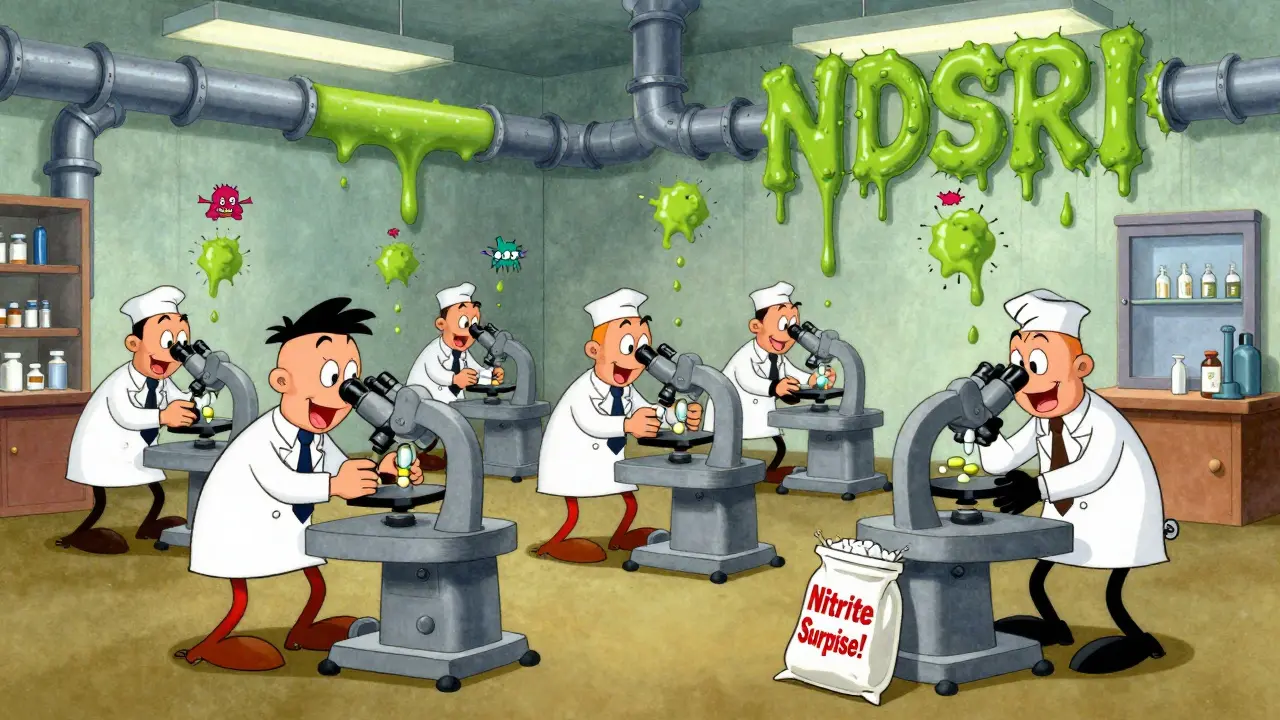
That’s where NDSRIs - nitrosamine drug substance-related impurities - come in. These are unique to each drug. N-nitroso-varenicline, for example, isn’t the same as NDMA. The FDA created individual acceptable intake limits for each, some as low as 96 ng/day. The EMA, by contrast, used broader thresholds. This made compliance harder for manufacturers, but also more precise.
The FDA’s original deadline for full NDSRI compliance was August 1, 2025. But in June 2025, they changed course. Instead of demanding full compliance by that date, they now accept progress reports. Manufacturers must submit detailed plans showing how they’re identifying root causes, redesigning processes, and gathering stability data. This shift didn’t mean the problem was solved - it meant regulators realized how hard it was to fix.
What Happens When a Drug Is Recalled
A Class II recall is one of the most serious actions the FDA can take. It means the drug may cause temporary or medically reversible health problems - or that it poses a serious risk of harm. When a nitrosamine-contaminated drug is recalled, it’s pulled from shelves immediately. Pharmacies can’t sell it. Hospitals can’t use it. Patients have to switch to another brand or wait for a replacement.
The fallout isn’t just public health. It’s financial. One mid-sized generic manufacturer spent $2 million and 18 months to fix their metformin line. They had to revalidate every step of production, test every batch with ultra-sensitive LC-MS/MS equipment, and find new suppliers for excipients. For small companies, that’s a death sentence. Many couldn’t afford it. Between 2018 and 2022, 15-20% of ARB products experienced shortages because manufacturers couldn’t retool fast enough.
Now, only the biggest players can compete. Teva, Fresenius Kabi, and Sun Pharmaceutical have invested heavily in testing labs and reformulation teams. Smaller manufacturers are being pushed out. Evaluate Pharma’s 2025 report found that nitrosamine compliance costs have cut generic drug profit margins by 3-5 percentage points across the industry.
How Manufacturers Are Trying to Fix It
Success stories exist - but they’re rare. One company caught nitrosamine risk during development, not after launch. They switched from a secondary amine-based excipient to a different one, redesigned their drying process, and avoided a recall entirely. That’s the ideal path.
Most companies didn’t get that lucky. Many tried to fix one source - like a contaminated supplier - only to find another nitrosamine forming elsewhere. One manufacturer replaced a nitrite-containing solvent, but then found NDEA forming in their packaging material. Another fixed their API synthesis, only to discover nitrosamines appearing during long-term storage. Each fix took months. Each failure cost money. Each cycle delayed product availability.
Today, the best manufacturers do three things:
- Test every batch with LC-MS/MS equipment capable of detecting nitrosamines at 0.3 ng/mL
- Map every possible contamination pathway - from raw materials to packaging
- Build stability data over 12-24 months to prove reformulated products won’t degrade
It’s not just about chemistry. It’s about supply chain control. One European API supplier had to replace all their magnesium stearate after finding nitrite impurities from a single batch. That took 14 months. No one knew the impurity was there until a customer’s product failed.
What This Means for Patients
If you’re taking a generic blood pressure pill, antidepressant, or diabetes medication, you should know: the risk of nitrosamine exposure is now low - but not zero. The FDA’s updated guidance and delayed deadlines mean more drugs are being tested, more reformulations are underway, and more products are being cleared for sale.
But don’t assume your current pill is safe. If your medication was recalled in the past - valsartan, ranitidine, metformin - check with your pharmacist. The FDA’s website lists all recalled products. If your drug was reformulated after 2022, it’s likely safer. If it’s the same formulation from 2018, ask if it’s been tested.
Patients should also know: switching brands isn’t always easy. Insurance plans often push for the cheapest option - even if it’s the one with a history of contamination. You have the right to ask for a different generic or the brand-name version. Pharmacists can help you navigate that.
The Road Ahead
Nitrosamine contamination isn’t going away. The FDA has made it clear: this is a top priority. Lilun Murphy, director of the Office of Generic Drugs, warned in October 2025 that manufacturers must treat this as a permanent part of quality control - not a temporary crisis.
Expect more testing requirements. More drug classes. More recalls. The FDA is already looking at antibiotics, antivirals, and even over-the-counter medications for potential nitrosamine risks. The tools are there. The methods are proven. The challenge now is scaling them.
For manufacturers, the message is simple: don’t wait for a recall. Test early. Reformulate early. Document everything. For regulators, the lesson is that strict deadlines don’t work if the industry can’t meet them. For patients, the takeaway is this: drug safety isn’t guaranteed. It’s earned - through testing, transparency, and constant vigilance.