Accommodation Eligibility Checker
Your Situation
Results
What Counts as a Medication Side Effect That Needs Accommodation?
Not every side effect from a prescription drug qualifies for workplace accommodation. The key is whether the side effect substantially limits a major life activity-like concentrating, walking, seeing, or staying awake-while you’re taking medication as prescribed. This isn’t about discomfort; it’s about function. If your medication causes drowsiness so severe you can’t safely operate machinery, or nausea that makes it impossible to sit at your desk for more than 30 minutes, those are real barriers. The EEOC makes it clear: it’s not the medication itself that triggers protection, but how it affects your ability to do your job.
Take someone on a new antidepressant. They might feel foggy in the mornings. If they’ve always been on time and accurate, but now they’re missing deadlines because they can’t focus until noon, that’s a functional change. Or a person on insulin for diabetes might need to eat at specific times to avoid low blood sugar. If their job requires them to be on the floor all day with no breaks, that’s a conflict. These aren’t excuses-they’re medical realities. Employers can’t ignore them just because they’re not visible.
When Is an Employer Required to Act?
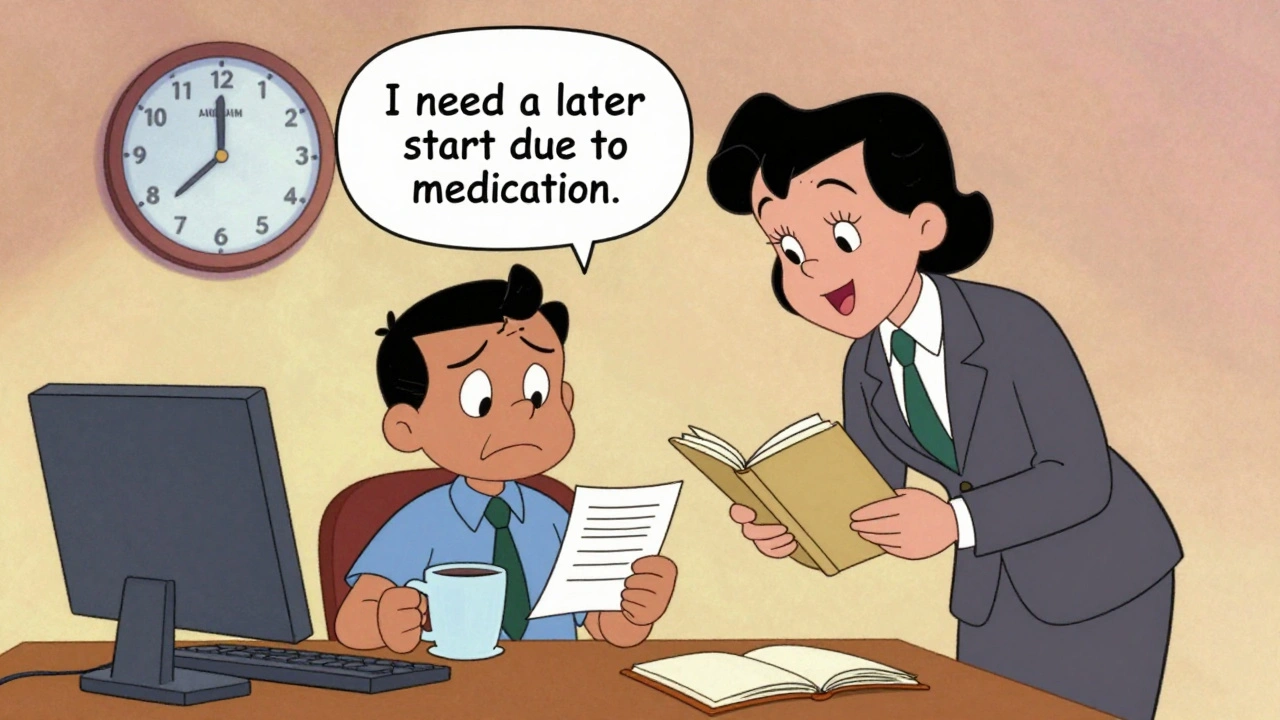
Employers must respond when an employee asks for an accommodation because of side effects from legally prescribed medication. You don’t need to say “I have a disability.” You just need to say something like, “I’m on a new medication that makes me drowsy in the morning, and I need to come in an hour later for the next few weeks.” That’s enough to start the process. The ADA doesn’t require perfect wording. It requires engagement.
Once you make the request, the employer has to start the “interactive process.” That means they can’t just say no or ignore you. They have to talk to you. Ask questions. Maybe they’ll ask for a note from your doctor explaining the side effects and how long they’re expected to last. But here’s the catch: they can’t demand to know your exact diagnosis or which drug you’re taking. They only need to know what the side effects are and how they affect your work. If your doctor says you get dizzy after taking your blood pressure pill at 8 a.m., that’s all they need. Not your prescription bottle.
Common Accommodations That Actually Work
Most accommodations for medication side effects are simple, low-cost, and temporary. The Job Accommodation Network found that 78.6% of these requests are resolved successfully. Here’s what works:
- Flexible start and end times: If your medication makes you sleepy in the morning, shifting your schedule to 10 a.m. to 6 p.m. might be all you need. This is the most common request-43.2% of cases.
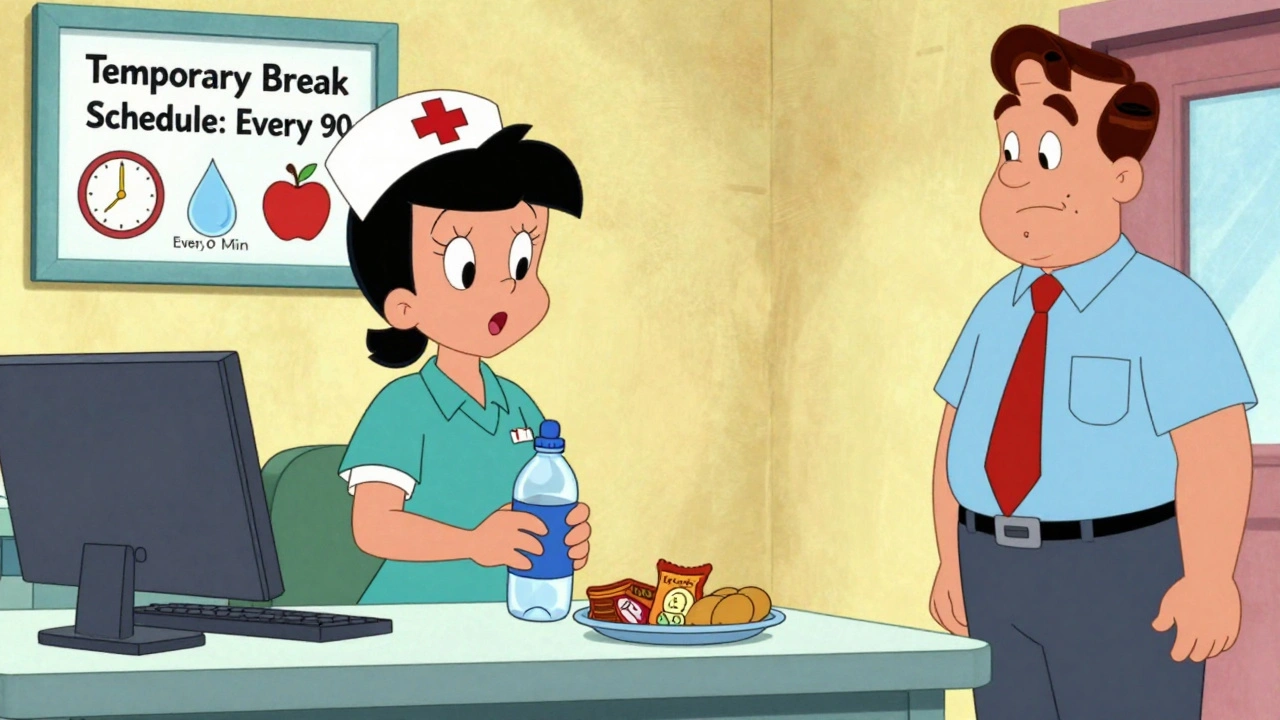
- Modified break schedules: Need to eat or drink something every 90 minutes to avoid nausea? Letting you take short, frequent breaks instead of one long lunch can make all the difference. This comes up in nearly 30% of cases.
- Remote or hybrid work: Especially after the pandemic, working from home became a go-to solution. If you’re recovering from surgery and on pain meds, doing your job from a quiet space can reduce side effects like dizziness or fatigue. Forty-three percent of new accommodation requests now involve remote work.
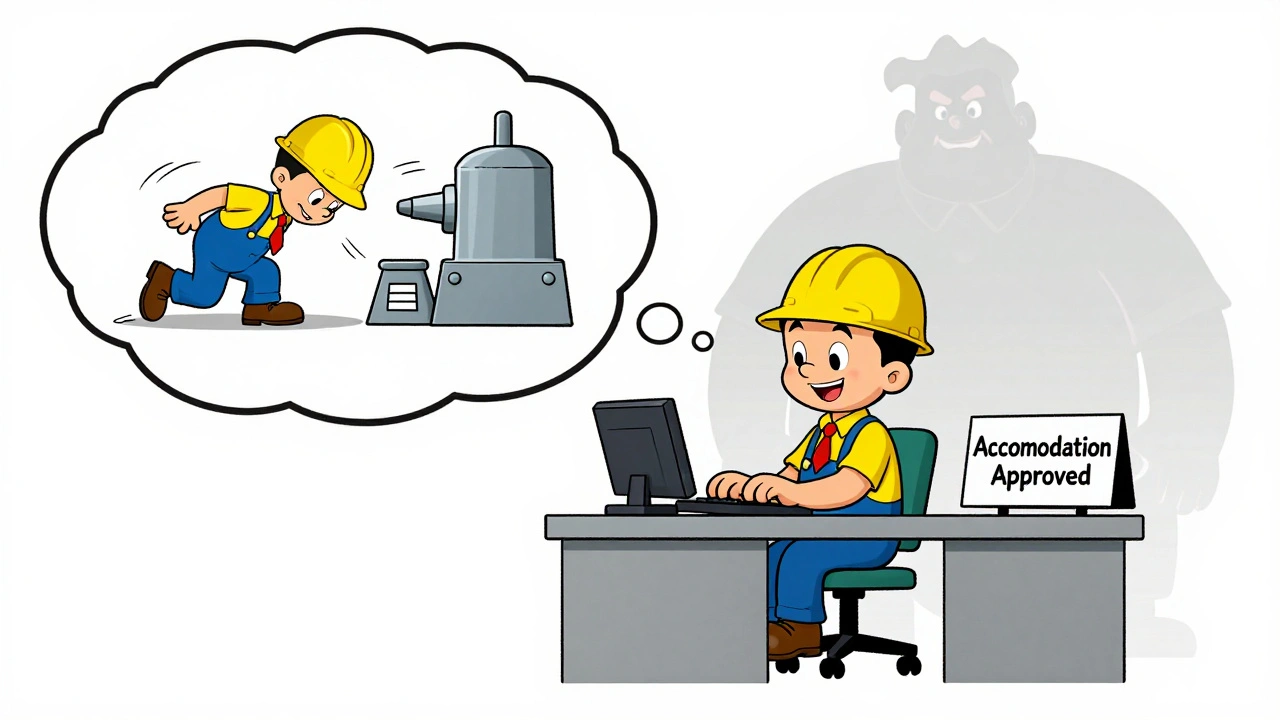
- Temporary reassignment: If you’re on chemo and can’t stand for long hours, moving you to a desk job for a few months is reasonable. This happens in about 12% of cases.
- Allowing food or drinks at your workstation: Many medications cause dry mouth, nausea, or low blood sugar. Allowing water, snacks, or gum at your desk isn’t a luxury-it’s a medical necessity.
These aren’t perks. They’re adjustments that let you keep your job without risking your health.
What Employers Can’t Do
Some managers think accommodations mean lowering standards. They don’t. You still have to do your job. If you’re a pilot, you can’t ask for an accommodation to fly while on sedatives. If you’re a surgeon, you can’t ask to operate while on strong painkillers. Essential functions stay essential.
Employers also can’t:
- Require you to take a different medication
- Fire you because you’re on medication
- Ask for your full medical records
- Force you to disclose your diagnosis
- Deny accommodation just because “everyone else can handle it”
And here’s a big one: they can’t assume side effects are dangerous just because the drug is “strong.” A 2023 court case in California ruled that an employee in a warehouse who took opioids for chronic pain couldn’t be fired just because the company had a blanket policy against opioids-even though he had zero safety incidents in three years. The court said: “Individual performance matters more than general assumptions.”
Safety-Sensitive Jobs Are Different-But Not Exempt
If you work in transportation, healthcare, or manufacturing, your employer might push back harder. That’s because safety risks are real. But even here, blanket bans are illegal. The EEOC says employers must assess each case individually. Can you still perform your duties safely? Is there a way to reduce risk?
For example, a truck driver on blood pressure medication that causes dizziness might be denied a long-haul route-but could still drive local routes with shorter shifts. A nurse on anti-seizure medication might be reassigned from night shifts if they cause confusion, but still work daytime triage. The goal isn’t to remove people-it’s to find a safe way to keep them working.
Studies show that 73% of accommodation denials in safety-sensitive roles are upheld in court-but only when employers have solid, documented proof of risk. If they just say, “We don’t allow people on that drug,” they lose. If they say, “We reviewed your medical records, consulted with an occupational physician, and found your side effects are minimal and manageable,” they’re on solid ground.
What Happens If Your Request Is Denied?
Denial doesn’t mean the end. If your employer refuses without engaging in the interactive process, you have rights. The EEOC received over 2,200 charges related to medication side effect accommodations in 2022-up 23% from 2019. Many of those cases were settled for over $68,000. Why? Because courts see refusal to talk as discrimination.
If you’re denied, document everything. Save your emails. Write down dates and what was said. Get a copy of your doctor’s note. Then file a charge with the EEOC. You don’t need a lawyer to start. The EEOC’s website has a simple online form. Most cases are resolved through mediation before they go to court.
And here’s something most people don’t know: if your employer didn’t even try to find a solution, you can ask for punitive damages. That’s extra money on top of lost wages, meant to punish bad behavior. In nearly 30% of cases where employers ignored the interactive process, courts added punitive damages.
How Employers Can Get This Right
Companies that handle this well don’t just follow the law-they save money and talent. Organizations with formal accommodation policies see 19.3% lower turnover among employees on medication. That’s not just good ethics-it’s good business.
Best practices include:
- Training managers on the interactive process-companies that do this see 42% fewer complaints.
- Keeping a log of accommodations: what was requested, how long it lasted, and whether performance improved.
- Using templates from the Department of Labor’s MAXIMIZING PRODUCTIVITY initiative for common scenarios.
- Not rushing decisions. The average resolution time for these requests is 14.3 business days. That’s not a delay-it’s due diligence.
And remember: temporary accommodations are okay. If your side effects will fade in two weeks, give it two weeks. Don’t wait for a crisis to act.
Why This Matters More Than Ever
More than half of Americans take at least one prescription drug. That number keeps rising. Mental health medications, pain treatments, and ADHD drugs are all common-and many come with side effects that impact work. Yet, 68% of people on psychiatric meds still feel discriminated against at work, according to Mental Health America.
This isn’t just about legal compliance. It’s about keeping skilled, experienced people in their jobs. People who know their roles, who’ve built relationships, who’ve earned trust. Losing them over a side effect that can be managed with a simple schedule change is short-sighted.
The law is clear: if you’re taking medication as prescribed and it affects your work, your employer must work with you. Not punish you. Not ignore you. Not assume. Engage. Adjust. Support.
Can my employer force me to take a different medication?
No. Employers cannot require you to switch medications, even if they think another drug would cause fewer side effects. The choice of medication is between you and your doctor. They can only ask how the current medication affects your ability to do your job-not why you chose it.
Do I have to tell my boss I’m on medication?
You don’t have to say you’re on medication at all. You only need to explain that you’re experiencing side effects that affect your work and that you need an adjustment. You can say, “I’m having trouble staying alert in the mornings,” without mentioning pills or prescriptions.
What if my side effects are temporary?
Temporary side effects still qualify. If you’re adjusting to a new drug and feel foggy for two weeks, you’re still protected. The EEOC explicitly supports short-term accommodations during medication changes. Many employers approve these requests-63% of them do, according to SHRM.
Can my employer require a doctor’s note?
Yes, but only to confirm the side effects and how they impact your job. The note doesn’t need your diagnosis, medication name, or medical history. It should say something like: “The patient experiences dizziness for two hours after taking their morning dose, which affects their ability to operate equipment safely.” That’s enough.
What if I’m in a safety-sensitive job and my request is denied?
Employers can deny accommodations in safety-sensitive roles-but only if they can prove a real, documented risk. They can’t rely on general fears. They need objective medical evidence. If you believe your denial was unfair, you can file a charge with the EEOC. Many of these cases are won when employees provide medical documentation showing minimal side effects.
What to Do Next
If you’re struggling with side effects at work, don’t wait until you’re on the verge of quitting. Start the conversation. Write down what’s happening: when it occurs, how long it lasts, and how it affects your work. Talk to your doctor and ask for a brief note that focuses only on function-not diagnosis. Then schedule a private meeting with your manager or HR. Say you need to discuss an adjustment to help you perform better.
If you’re an employer, don’t guess. Train your managers. Know the rules. Engage in the process. The cost of getting it wrong-lawsuits, turnover, lost productivity-is far higher than the cost of a flexible schedule or a modified break.
This isn’t about special treatment. It’s about fairness. People shouldn’t have to choose between their health and their job. The law says they don’t have to. Now it’s up to us to make sure that promise is kept.