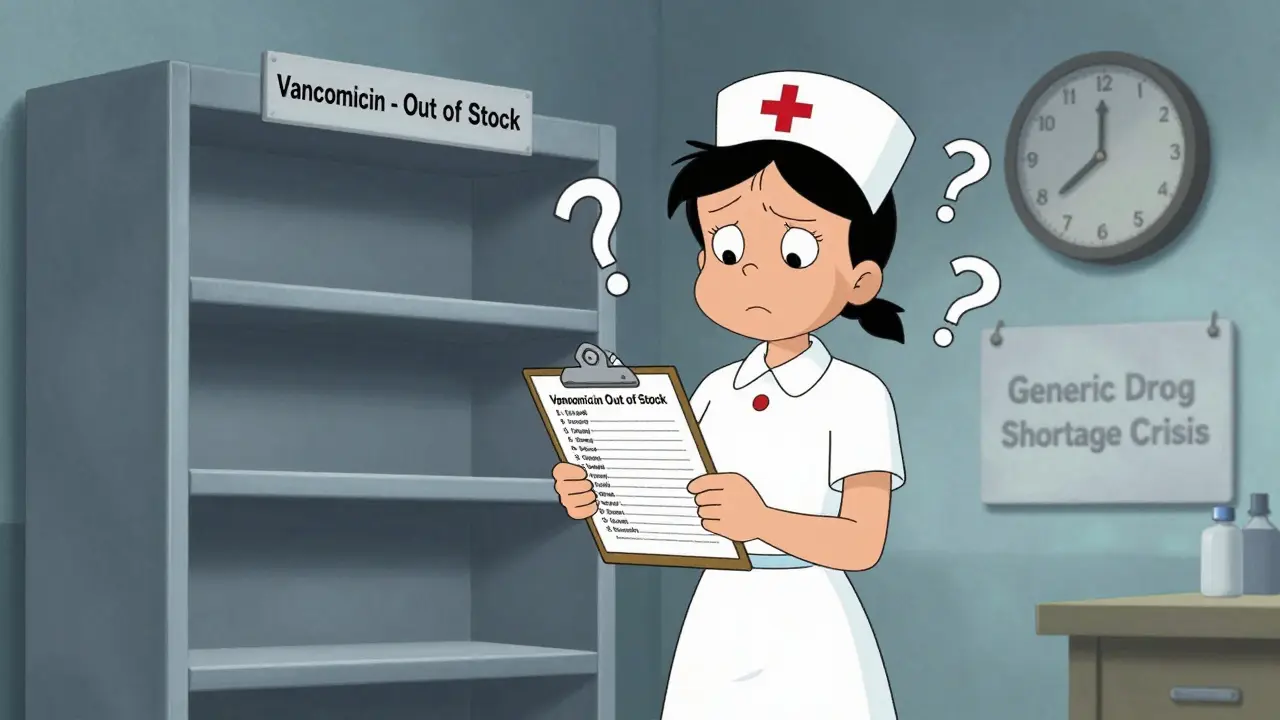
By the end of 2025, there are still 270 active drug shortages in the U.S.-and nearly all of them are generic medications. These aren’t rare glitches. They’re systemic failures that directly affect your ability to get the medicine you need. For many, it’s not about choice-it’s about survival. A cancer patient can’t switch to another chemo drug because the alternatives don’t exist. A diabetic can’t find insulin because the only manufacturer had a quality shutdown. A nurse in a rural hospital spends hours each week trying to find a replacement for vancomycin that’s been out of stock for eight months. This isn’t an anomaly. It’s the new normal.
Why Do Generic Drugs Keep Running Out?
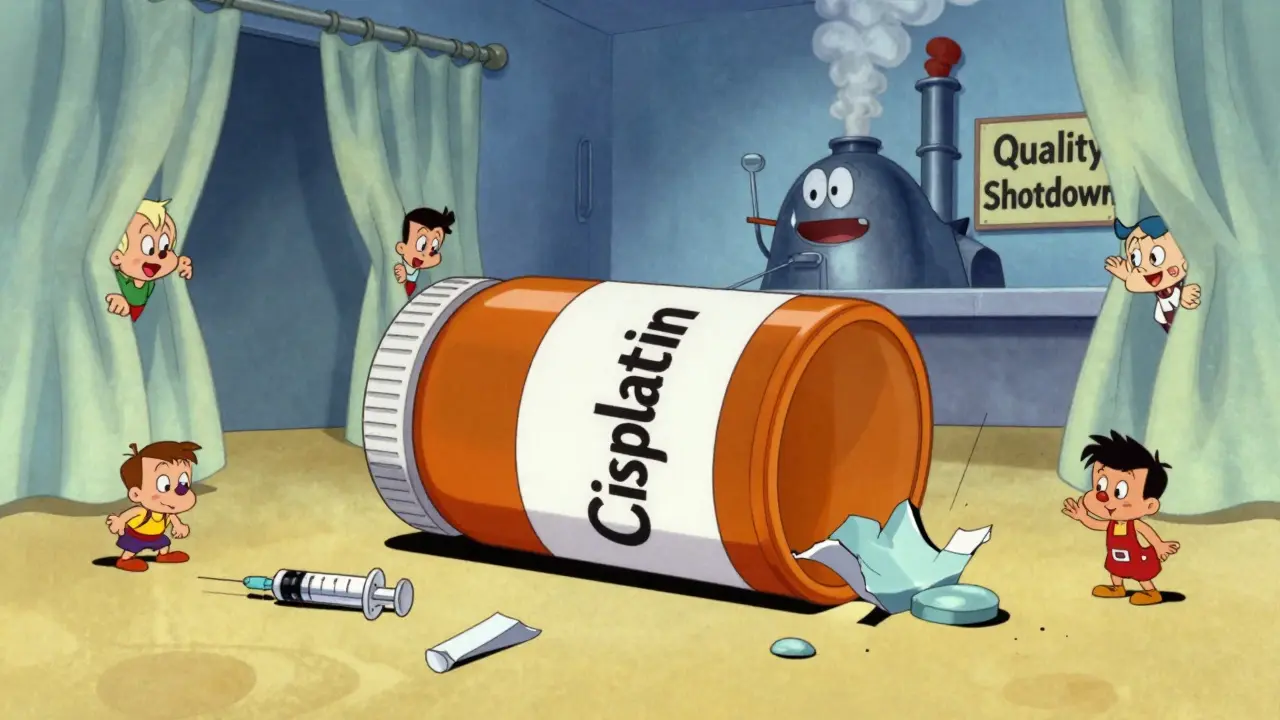
Generic drugs make up 90% of all prescriptions filled in the U.S., but they account for more than 70% of all shortages. Why? Because the system is built to fail them. Unlike brand-name drugs, which can charge high prices to recoup R&D costs, generics compete on price. The profit margins are razor-thin-often just 5% to 10%-compared to 30% to 40% for brand-name drugs. When a manufacturer can’t make money, they don’t invest in quality, backup equipment, or extra inventory. They cut corners. And when something breaks, there’s no buffer.Many of these drugs are made in just one or two factories. The FDA found that 70% of generic drugs have only one or two approved manufacturers. That means if one facility shuts down for a quality issue-a common problem-there’s no one else to step in. In 2023, over 60% of all shortages were caused by manufacturing and quality problems, according to the FDA. Sterile injectables like antibiotics, chemotherapy drugs, and IV fluids are especially vulnerable. They require clean rooms, complex processes, and strict controls. One tiny contamination can wipe out months of production.
And it’s not just U.S. factories. More than half of all drugs used in America are made overseas. About 80% of the active ingredients come from just two countries: China and India. That creates a single point of failure for the entire supply chain. A flood in India, a regulatory inspection in China, or even a labor strike can ripple across U.S. hospitals. The median length of a shortage has doubled since 2011-from 12 months to 24 months. These aren’t temporary hiccups. They’re long-term disruptions.
Who Gets Hurt the Most?
It’s not just hospitals. It’s patients. A 2022 survey by the American Medical Association found that 63% of pharmacists reported drug shortages led to serious patient harm. That includes missed doses, delayed treatments, and even deaths. Oncology departments are hit hardest. Nearly 70% of cancer centers reported having to change chemotherapy regimens because drugs like cisplatin or doxorubicin weren’t available. These aren’t interchangeable. Changing the drug can mean lower effectiveness, more side effects, or worse survival rates.Even common medications are affected. Vancomycin, a life-saving antibiotic for MRSA infections, has been out of stock in many hospitals for over a year. Pharmacists are forced to use alternatives that are less effective, more expensive, and sometimes more toxic. Patients with chronic pain are being denied refills on opioids because there’s no supply-despite having legitimate prescriptions. One pharmacist on Reddit wrote: “We’re seeing more ER visits for uncontrolled pain because patients can’t get their meds.”
Independent pharmacies are drowning too. The National Community Pharmacists Association found that 78% of small pharmacies spend an average of 12.3 hours a week tracking down shortages. Forty-three percent said patients gave up on their prescriptions entirely because they couldn’t get them or couldn’t afford the alternatives. That’s not just inconvenience. That’s medical abandonment.
The Hidden Costs: Time, Stress, and System Overload
Managing drug shortages isn’t just a pharmacy problem-it’s a full-system crisis. Pharmacists now spend 15 to 20 hours a week on shortage-related tasks: finding substitutes, updating electronic records, reprogramming automated dispensers, training staff on new protocols. That’s time taken away from patient counseling, medication reviews, or just catching up on paperwork.Hospitals have to create separate protocols for at least 10 different drug categories, according to the USP Drug Shortage Impact Report. That means pharmacists need to know not just one way to treat an infection, but three or four alternatives-each with different dosing, side effects, and interactions. That’s not how pharmacy school trained them. This knowledge gap is real. Many new pharmacists have never seen a full stock of vancomycin in their career.
And the staffing crisis is getting worse. Seventy-two percent of hospitals say drug shortages have made their existing staff shortages worse. When you’re already short on nurses and pharmacists, adding hours of extra work for every shortage just pushes people out the door. The American Hospital Association estimates hospitals spend $213 million a year just managing these disruptions. That’s money that could go to hiring more staff, upgrading equipment, or improving patient care.
Why Don’t More Companies Make These Drugs?
You’d think with so much demand, more manufacturers would jump in. But the economics don’t add up. The U.S. generic drug market was worth $122 billion in 2024-but average gross margins have dropped from 35% in 2010 to just 18% today. The market is dominated by a handful of big players. The top 10 manufacturers now control 60% of the market, up from 45% in 2015. That consolidation means fewer competitors, less innovation, and less pressure to improve quality.Even worse, the number of FDA-registered generic manufacturing facilities in the U.S. has dropped by 22% since 2015-from 1,842 to just 1,437. Why? Because it’s expensive to build and maintain sterile facilities. And when you’re making a drug that sells for pennies, you don’t invest in upgrades. You just keep running until something breaks. Then you shut down, wait for an FDA inspection, fix the problem, and hope you get back in business before your customers find someone else.
Regulatory citations for quality issues have jumped 35% since 2020. That’s not because manufacturers are getting sloppier-it’s because the FDA is seeing more problems. And when a facility gets cited, it can be shut down for months. No one else can make the drug. No one else is ready to step in.

What’s Being Done-and Why It’s Not Enough
There have been efforts to fix this. In 2020, President Biden signed Executive Order 14050, which created an Essential Medicines List and pushed for more domestic production. Shortages of those critical drugs dropped 32% between 2020 and 2023. But since 2023, the numbers have started climbing again. The FDA’s Drug Shortage Task Force has proposed four solutions: diversify manufacturing locations, offer financial incentives for reliable supply, adopt advanced manufacturing tech, and improve early warning systems.But none of these fix the core problem: the market rewards the lowest price, not the most reliable supply. As FDA Commissioner Robert Califf told Congress in 2024, “The current market structure for generic drugs does not incentivize reliability and quality over lowest price.”
Proposed tariffs of 50% to 200% on imported drugs could make things worse. If you raise the cost of APIs from China or India, manufacturers will either raise prices (which they can’t do with generics) or stop making the drug altogether. SVB Securities warned in early 2025 that tariffs could disrupt supply chains for chemotherapy drugs and IV fluids-exactly the ones we’re already running out of.
The Congressional Budget Office predicts shortages will hit 350 by the end of 2026 unless something changes. And the Congressional Research Service says bluntly: “Without addressing the pricing structure that disincentivizes investment in quality manufacturing, generic drug shortages will remain a persistent threat to U.S. healthcare for the foreseeable future.”
What Can You Do?
If you’re a patient: Talk to your pharmacist. Ask if your medication is in short supply. Ask about alternatives. Don’t assume your doctor knows what’s available. Pharmacists are on the front lines-they know what’s in stock, what’s on backorder, and what’s been discontinued.If you’re a caregiver: Keep extra prescriptions on hand if possible. Some drugs, like insulin or seizure meds, can’t be skipped. Ask your provider if a 90-day supply is an option.
If you’re a healthcare worker: Document every shortage. Report delays, substitutions, and adverse outcomes. Your data matters. It’s how we prove this isn’t just an inconvenience-it’s a safety crisis.
This isn’t about blaming manufacturers or regulators. It’s about recognizing that a broken market is costing lives. We’ve built a system that values cheap drugs over reliable access. And now, we’re paying the price.
Why are generic drug shortages getting worse?
Generic drug shortages are worsening because manufacturers make very little profit on these drugs-often just 5% to 10%-so they avoid investing in backup production, quality improvements, or inventory. Many generics are made in just one or two factories, often overseas. When one facility shuts down due to quality issues or supply chain problems, there’s no one else to fill the gap. The system rewards the lowest price, not reliability.
Are brand-name drugs also in short supply?
Yes, but not nearly as often or as severely. Between 2018 and 2023, there were over 1,300 shortages of generic drugs compared to about 600 for brand-name drugs. Brand drugs usually have therapeutic alternatives, higher profit margins, and more manufacturing capacity. Generic drugs, which make up 90% of prescriptions, face the most frequent and longest shortages because they’re cheaper and harder to replace.
What types of drugs are most likely to be in short supply?
Sterile injectables are the most vulnerable-about 60% of all shortages. These include antibiotics like vancomycin, chemotherapy drugs like cisplatin, IV fluids like saline, and anesthetics. They require complex, expensive manufacturing under sterile conditions. Other high-risk drugs include older generics with low profit margins, like thyroid hormone or insulin, and drugs with only one or two manufacturers.
How do drug shortages affect patient outcomes?
Sixty-three percent of pharmacists report that shortages have led to serious patient harm, including delayed treatments, incorrect dosing, and increased side effects. Cancer patients may get less effective chemo. Diabetics may run out of insulin. People with infections may get weaker antibiotics. In some cases, patients have died because a life-saving drug wasn’t available. The risk is highest for critical, non-substitutable medications.
Can I get my medication from another country?
Legally, no. The FDA does not allow individuals to import prescription drugs from other countries for personal use, except in rare, limited cases. Even if you find a cheaper or available version online, it may be counterfeit, expired, or unsafe. The safest option is to work with your pharmacist and doctor to find an approved alternative or adjust your treatment plan.
Is there a list of currently shortage drugs?
Yes. The American Society of Health-System Pharmacists (ASHP) maintains an up-to-date public list of active drug shortages on their website. The FDA also publishes a list of drugs in shortage, including the reasons and estimated resolution dates. Pharmacists and hospitals use these lists daily to plan inventory and patient care.