
Licorice Interaction Risk Calculator
Assess Your Risk
Enter your licorice consumption and medication type to see potential interaction risks.
Results
Select values to see risk assessment
If you're taking medication for high blood pressure and you enjoy licorice candy, tea, or herbal supplements, you might be unknowingly making your treatment less effective-or even dangerous. This isn't a myth or a warning from an overcautious doctor. It’s backed by decades of clinical research, real patient cases, and measurable physiological changes in the body. The problem? licorice root interferes with how your blood pressure medications work, and the effects can show up fast.
What’s in licorice root that causes the problem?
The main culprit is a compound called glycyrrhizin. It’s what gives licorice its sweet taste, but it’s also what turns it into a silent disruptor in your body. Glycyrrhizin breaks down into glycyrrhetic acid, which blocks an enzyme called 11β-hydroxysteroid dehydrogenase type 2. That enzyme normally protects your kidneys from being flooded by cortisol, a stress hormone that acts like aldosterone-a hormone that tells your body to hold onto salt and water. When that enzyme is blocked, cortisol starts behaving like aldosterone. Your kidneys hang onto more sodium, push out more potassium, and hold onto extra fluid. That means more blood volume, higher pressure in your arteries, and a direct counterattack on everything your blood pressure meds are trying to do. You don’t need to eat pounds of licorice for this to happen. Studies show that consuming more than 100 mg of glycyrrhizin daily for two weeks can trigger noticeable changes. That’s about 50 grams of real licorice candy-or a few cups of licorice tea per day. Some supplements contain even higher concentrations.How it breaks down your blood pressure meds
Different classes of blood pressure medications work in different ways. Licorice root messes with all of them, but some are hit harder than others.- ACE inhibitors (like lisinopril): These drugs relax blood vessels by blocking a chemical that narrows them. Licorice increases fluid volume so much that the drug can’t keep up. Studies show effectiveness drops by 30-50%.
- ARBs (like losartan): These block the same pathway as ACE inhibitors but at a different point. Licorice still overwhelms the system, reducing their effectiveness by about 25%.
- Calcium channel blockers (like amlodipine): These relax artery walls. Licorice’s fluid retention and potassium loss make them less able to lower pressure-studies show a 15-20% drop in control.
- Potassium-sparing diuretics (like spironolactone): This is the worst combo. These drugs help you keep potassium while flushing out fluid. Licorice does the opposite: it drains potassium and swells your blood volume. In documented cases, it completely neutralized the drug’s effect within 7-10 days.
It’s not just candy
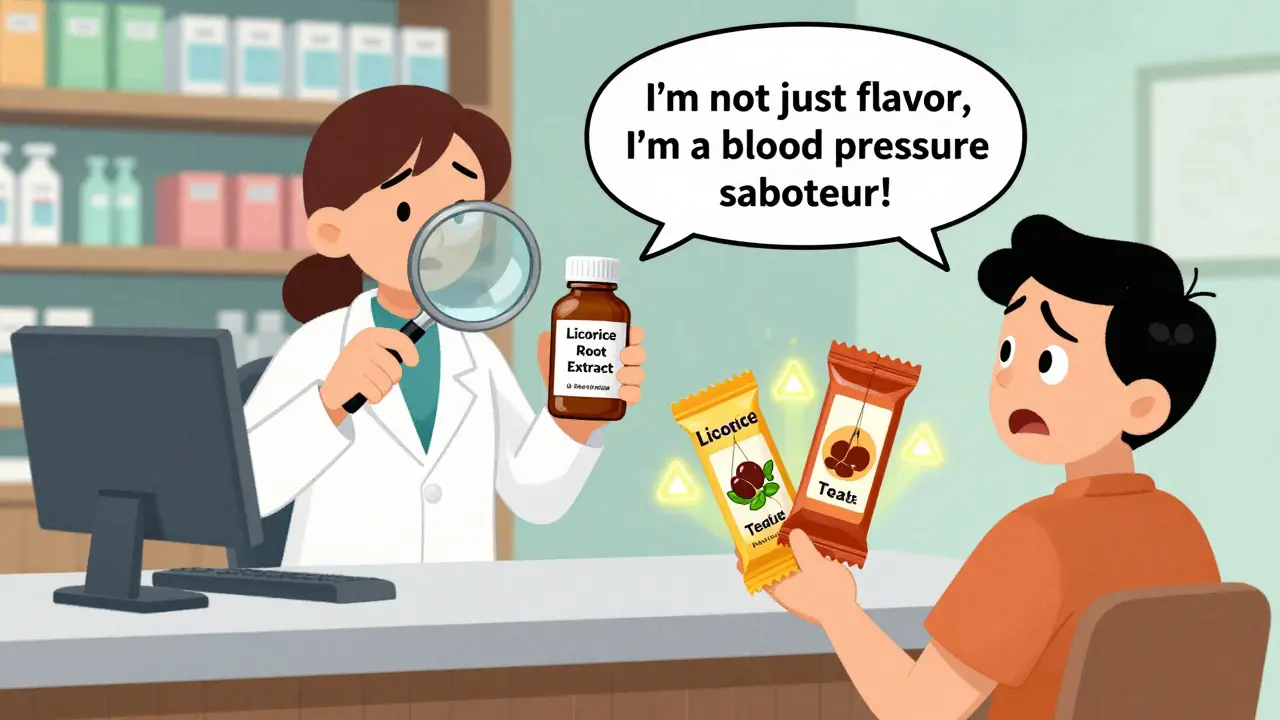
Most people think they’re safe if they avoid black licorice candy. But here’s the catch: in the U.S., about 95% of licorice-flavored candies don’t even contain real licorice root. They use anise oil for flavor. That’s harmless. The danger comes from products that actually list Glycyrrhiza glabra or licorice extract on the label. That includes:- Herbal supplements marketed for digestion, liver health, or adrenal support
- Traditional Chinese medicine formulas (25% contain licorice root)
- Some cough syrups and throat lozenges
- Herbal laxatives (30% contain licorice)
- Even some tobacco products and teas
What your body shows when it’s affected
The signs aren’t always obvious. You might not feel anything until your blood pressure skyrockets. But there are measurable changes:- Low potassium: Levels can drop below 3.0 mmol/L (normal is 3.5-5.0). This can cause muscle cramps, weakness, or even irregular heartbeat.
- High blood pressure: Systolic increases of 10-30 mmHg are common in people already on meds. In some cases, it jumps over 40 mmHg.
- Fluid retention: Swelling in ankles, unexplained weight gain, or puffiness in the face.
- Headaches or dizziness: Often mistaken for stress or lack of sleep.
What about deglycyrrhizinated licorice (DGL)?
If you’re taking licorice for digestive issues-like acid reflux or ulcers-you might have heard of DGL. That stands for deglycyrrhizinated licorice. It’s a version where most of the glycyrrhizin has been removed. Studies show DGL contains less than 1% glycyrrhizin and doesn’t affect blood pressure or potassium levels. It’s safe for people on antihypertensive meds. But here’s the catch: not all products labeled “DGL” are created equal. Some still contain traces. Always check the label for glycyrrhizin content. If it’s not listed, ask the manufacturer.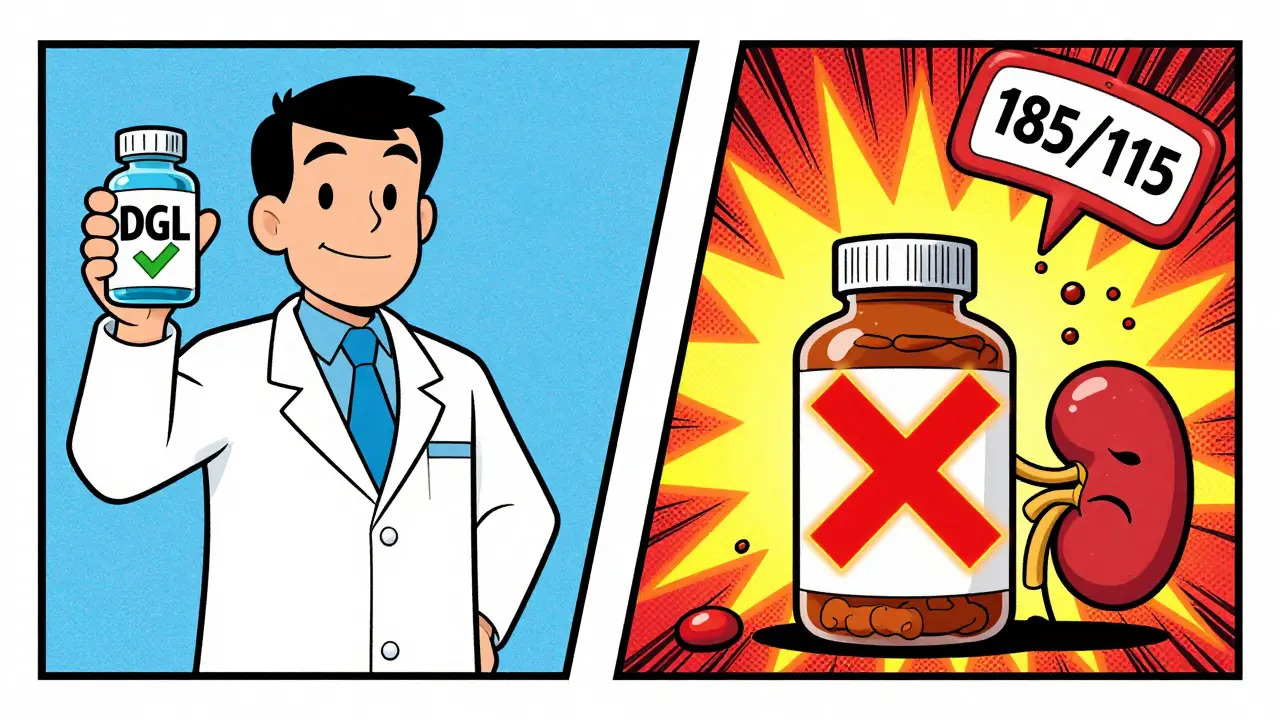
What should you do?
If you’re on blood pressure medication, here’s your action plan:- Check every product. Look for “Glycyrrhiza glabra,” “licorice root,” or “licorice extract.” Avoid them. Anise, fennel, or “natural flavor” are safe.
- Talk to your pharmacist. They can scan your supplements and herbal products for hidden licorice. Most don’t know to ask-but they can check.
- Don’t assume “natural” means safe. Herbal doesn’t mean harmless. Licorice root is a powerful bioactive compound, not a harmless tea.
- Monitor your numbers. If you’ve consumed licorice in the last month and your blood pressure is rising, stop immediately and get checked.
- Switch to DGL if you need licorice for digestive support. But only if it’s clearly labeled and verified.
Why isn’t this better known?
The U.S. Food and Drug Administration classifies licorice root as GRAS-Generally Recognized As Safe-for flavoring. But that’s only for small amounts in candy or soda. It doesn’t apply to supplements or daily herbal use. The European Union requires warning labels on products with more than 10 mg of glycyrrhizin per serving. The U.S. doesn’t. And a 2021 survey found only 37% of supplement labels warn about blood pressure interactions. Meanwhile, global sales of licorice root supplements hit $187 million in 2022. The market is growing. But the warnings aren’t.Bottom line
Licorice root isn’t just a sweet treat. It’s a potent substance that directly undermines your blood pressure treatment. It doesn’t matter if you’ve been taking it for years. One new tea, one new supplement, one candy bar with real licorice-and your meds stop working. If you’re on high blood pressure medication, skip the licorice. Not “sometimes.” Not “in moderation.” Just skip it. Your heart, kidneys, and blood pressure numbers will thank you.Can I have licorice-flavored candy if I’m on blood pressure meds?
Most licorice-flavored candy in the U.S. doesn’t contain real licorice root-it uses anise oil instead. That’s safe. But always check the ingredients. If it says "Glycyrrhiza glabra," "licorice extract," or "licorice root," avoid it. If it just says "natural flavor" or "anise," you’re likely fine.
How long does it take for licorice to affect blood pressure meds?
Effects can show up in as little as 7-10 days of daily use. In one documented case, a patient’s blood pressure spiked after just 5 days of drinking licorice tea. The compound glycyrrhizin has a half-life of about 14 hours, but its effects on mineralocorticoid pathways can linger for up to two weeks after you stop.
Does deglycyrrhizinated licorice (DGL) affect blood pressure?
DGL has the glycyrrhizin removed, so it doesn’t interfere with blood pressure medications. It’s safe for people on antihypertensives, as long as the product truly contains less than 1% glycyrrhizin. Always verify with the manufacturer if the label doesn’t specify the glycyrrhizin content.
Can licorice root cause low potassium?
Yes. Licorice root causes your body to lose potassium through urine. Levels can drop by 0.5-1.5 mmol/L within days. Normal potassium is 3.5-5.0 mmol/L. When it falls below 3.0, you risk muscle weakness, cramps, and heart rhythm problems. This is especially dangerous if you’re also on diuretics.
What should I do if I accidentally ate licorice while on blood pressure meds?
Stop consuming it immediately. Monitor your blood pressure closely over the next week. If your numbers rise more than 10-15 mmHg systolic, or if you feel dizzy, swollen, or weak, contact your doctor. You may need a potassium check and possibly an adjustment to your meds. Don’t wait for symptoms to get worse.