

That muffled hearing and the constant feeling of fullness in your ear is frustrating. You might reach for a cotton swab or a bobby pin, but those tools often push the wax deeper, causing more harm than good. The safer solution involves cerumenolytics. These are specialized agents designed to soften, loosen, and dissolve earwax (cerumen) so it can exit the ear canal naturally or be easily irrigated out.
You don't need a doctor's visit for most cases of earwax buildup. Medical consensus positions these softening drops as the first-line treatment before considering professional irrigation. By understanding which type works for your specific ear situation, you can clear that blockage safely from your kitchen counter.
What Are Cerumenolytics?
Earwax, or cerumen, is actually beneficial. It traps dust and protects the delicate skin of your ear canal. Problems arise when this wax hardens and blocks the canal, a condition known as cerumen impaction. This affects about 6% of the general population and up to 30% of elderly individuals.
The American Academy of Family Physicians (AAFP) notes that these agents serve two purposes. First, they improve the success rate of irrigation procedures. Second, and more commonly for home users, they function as standalone therapy to manage mild to moderate buildup.
Types of Earwax Softeners and How They Work
Not all ear drops work the same way. Choosing the right one depends on whether your earwax is dry and hard or moist and sticky. Here are the main categories available over-the-counter or via simple home recipes.
Carbamide Peroxide
This is the active ingredient in popular brands like Debrox and Murine. It contains 6.5% carbamide peroxide. When it touches moisture in your ear, it breaks down into hydrogen peroxide and urea. This reaction creates bubbles that help lift the wax away from the ear canal walls.
- Usage: Apply 5-10 drops twice daily for up to 7 days.
- Best For: General buildup where you want a mechanical lifting action.
- Efficacy: A 2017 study in the Journal of Laryngology & Otology found it effective in 65% of cases.
Hydrogen Peroxide
You likely have this in your medicine cabinet already. However, you must dilute it. Pure hydrogen peroxide can irritate sensitive skin. ENT Care Centers recommend mixing 3% hydrogen peroxide with an equal amount of sterile water.
- Usage: Administer 5-10 drops while lying on your side. Keep the ear upward for 3-5 minutes to allow drainage.
- Best For: Cases with significant moisture content in the cerumen.
- Note: Harvard Health warns that undiluted solutions carry a higher risk of irritation.
Oils (Mineral, Baby, Olive)
If your earwax is particularly dry and hardened, oils are often superior to peroxides. They lubricate the canal and slowly soften the wax over time. Mineral oil, baby oil, and olive oil are all viable options.
- Usage: Apply 3-6 drops nightly for 3-4 consecutive days.
- Best For: Dry, hardened cerumen that resists quick dissolution.
- Efficacy: Studies show around 58% effectiveness, though individual results vary based on wax consistency.
Baking Soda Solution
This requires precise measurement to avoid irritation. Seattle Children's Hospital recommends a 15% concentration. Mix ¼ teaspoon (1.25 mL) of baking soda into 2 teaspoons (10 mL) of sterile water.
- Usage: Apply twice daily for 4 days.
- Best For: Those who prefer non-oily, non-peroxide alternatives.
Docusate Sodium
Originally a constipation medication (Colace), docusate sodium is sometimes used off-label by practitioners. An AAFP study found it superior to triethanolamine in augmenting irrigation success. Some clinicians use the contents of one 240 mg capsule mixed with water, leaving it in the ear for 30 minutes before irrigation.
Step-by-Step Application Guide
Using these drops incorrectly is the number one reason people think they "don't work." Proper technique is critical for penetration.
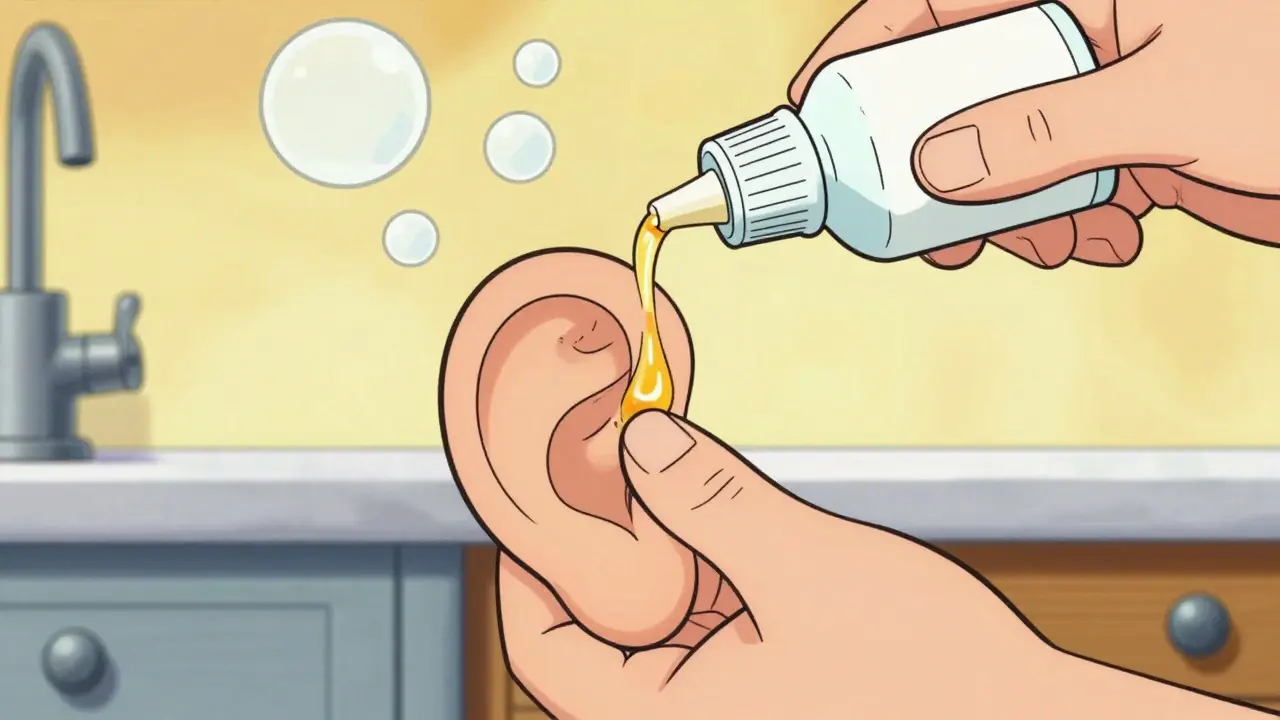
- Position Yourself: Lie down on your side with the affected ear facing upward. This uses gravity to help the drops travel deep into the canal.
- Administer Drops: Use the dropper to place the recommended number of drops (usually 5-10) into the ear. Do not insert the tip too deeply-stay within ¼ inch of the opening.
- Wait: Stay in that position for 5 to 10 minutes. Seattle Children's Hospital data shows that maintaining this position improves success rates by 40% compared to standing up immediately.
- Drain: Sit up and tilt your head to let the fluid and loosened wax drain out onto a tissue. Wipe only the outer ear.
- Repeat: Consistency matters. Most protocols require 3 to 7 days of daily application before attempting irrigation.
Safety Warnings and Contraindications
While generally safe, cerumenolytics are not for everyone. Using them in the wrong scenario can lead to pain, infection, or damage to the eardrum.
Do NOT use ear drops if you have:
- A perforated eardrum (hole in the eardrum).
- An active ear infection (otitis media or externa).
- Recent ear surgery.
- Tubes in your ears (tympanostomy tubes).
Harvard Health explicitly warns against use in these scenarios because the liquid can enter the middle ear, causing severe vertigo or infection. If you experience stinging, burning, or increased pain, stop use immediately. About 22% of negative reviews for hydrogen peroxide solutions cite stinging when concentrations are too high or used too frequently.
When Home Treatment Fails
Despite proper use, some impactions are too dense or complete for drops alone. Mayo Clinic data indicates that professional removal becomes necessary in approximately 25% of home treatment cases.
If you do not see improvement after 7 days of consistent drop usage, or if you experience sudden hearing loss, dizziness, or ear discharge, see a healthcare provider. They may perform microsuction or irrigation under direct visualization, which is safer than blind home attempts.

Comparison of Common Cerumenolytics
| Type | Active Ingredient | Treatment Duration | Best Wax Type | Key Risk |
|---|---|---|---|---|
| Carbamide Peroxide | 6.5% Carbamide Peroxide | Up to 7 days | General/Moist | Mild Irritation |
| Hydrogen Peroxide | 3% H2O2 (Diluted) | 1-3 days | Moist/Sticky | Burning if Undiluted |
| Oil-Based | Mineral/Olive Oil | 3-4 nights | Dry/Hardened | Low (Very Safe) |
| Baking Soda | 15% Baking Soda Sol. | 4 days | General | Irritation if Concentration High |
Frequently Asked Questions
How long does it take for ear drops to work?
Most cerumenolytics require 3 to 7 days of consistent application. Oils may take longer (3-4 nights) to soften very hard wax, while peroxide solutions may show effects sooner due to their bubbling action. Do not expect immediate clearance; patience is key.
Can I use olive oil to remove earwax?
Yes, olive oil is a safe and effective option, especially for dry, hardened earwax. Apply 3-6 drops nightly for 3-4 days. It lubricates the canal and gradually softens the wax without the chemical reaction of peroxides.
Is hydrogen peroxide safe for ears?
It is safe if diluted correctly. Use 3% hydrogen peroxide mixed with an equal part of sterile water. Undiluted peroxide can cause significant irritation and burning. Avoid it if you have a perforated eardrum or active infection.
Why do my ears hurt after using ear drops?
Pain can indicate an underlying infection, a perforated eardrum, or simply irritation from the solution. If you feel stinging or burning, rinse the ear with warm water and stop use. Persistent pain requires a doctor's evaluation.
Should I irrigate my ears after using drops?
Irrigation is optional and usually done after several days of softening. Use body-temperature water to avoid dizziness. If the wax has not softened sufficiently, irrigation may push it further back. Many people find that gravity and natural jaw movement clear the softened wax without irrigation.


Categories