
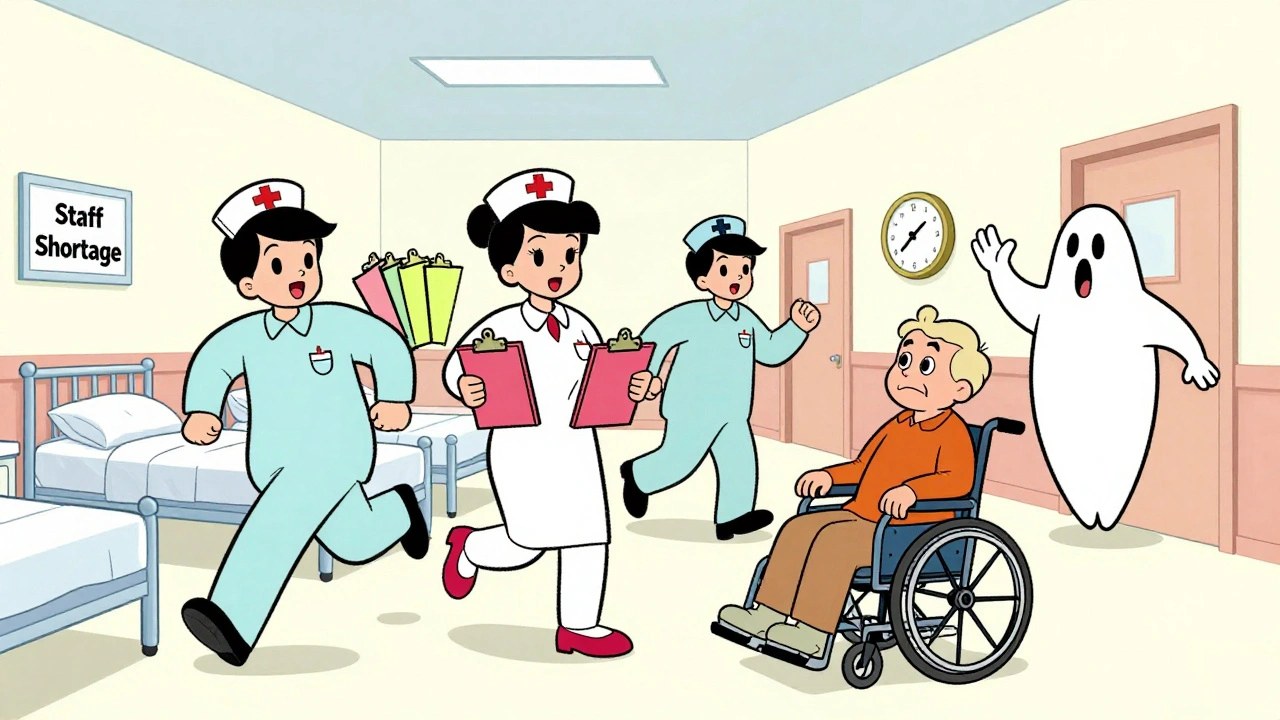
Every day, hospitals and clinics across the U.S. are making impossible choices. Beds stay closed because there aren’t enough nurses to staff them. Emergency rooms delay care because staff are stretched too thin. Patients wait hours - sometimes days - for basic treatment. This isn’t a temporary glitch. It’s the new reality of American healthcare, driven by a deepening healthcare worker shortage that’s hitting hospitals and clinics harder than ever.
Why Staffing Is Falling Apart
The problem didn’t start with the pandemic, but the pandemic made it explode. Before 2020, hospitals were already struggling to hire enough nurses and doctors. Now, the gap is wider than ever. The Health Resources and Services Administration (HRSA) estimates the U.S. will be short more than 500,000 registered nurses by 2030. That’s not a guess - it’s a projection based on who’s leaving, who’s retiring, and how few new nurses are coming in to replace them. Nearly half of all nurses are over 50. That means one in two nurses could retire in the next 10 to 15 years. At the same time, nursing schools are turning away over 2,300 qualified applicants each year - not because they lack interest, but because there aren’t enough faculty to teach them. It’s a broken pipeline. More people want to become nurses than ever before, but the system can’t train them fast enough. Doctors aren’t immune either. The Association of American Medical Colleges predicts a shortfall of 86,000 physicians by 2036. And it’s not just numbers - it’s burnout. Nurses report working 16-hour shifts with three or four patients at a time. In many units, the safe ratio is one nurse for every two patients. But in practice, it’s often one for five. That’s not just stressful - it’s dangerous.What Happens When There’s No One to Care
When staff are stretched too thin, patients pay the price. Studies show that hospitals with nurse-to-patient ratios above 1:4 see a 7% higher death rate. That’s not a small number. It’s thousands of lives lost each year because there weren’t enough people to monitor, respond, and intervene. Emergency departments are overwhelmed. The American College of Emergency Physicians found that understaffed ERs now have wait times that are 22% longer than they were in 2022. In rural Nevada, patients have reported waiting 72 hours just to be seen. In urban centers, the problem is just as bad - but more hidden. Patients get sent home with instructions to return if things get worse, because there’s no bed, no nurse, no time. Long-term care facilities are even worse off. They’re operating with 28% fewer nurses than before the pandemic. Many residents go hours without being turned, hydrated, or checked on. Families are seeing changes in their loved ones - confusion, bedsores, infections - and they don’t know whether it’s aging or neglect.Who’s Feeling the Pressure the Most
The shortage doesn’t hit everywhere the same. Rural hospitals are hit hardest. They have 37% higher vacancy rates than urban hospitals. Many rural clinics have shut down entirely because they can’t find staff willing to work for low pay in isolated areas. Meanwhile, big city hospitals can afford to pay travel nurses $185 an hour - but that only fixes the problem for a few months. And it drives a wedge between permanent staff, who earn $65 an hour, and the temporary workers brought in to fill gaps. Behavioral health is collapsing. There are 12,400 unfilled positions in mental health and substance use care nationwide - up 37% since 2023. People in crisis are being turned away from ERs because there’s no psychiatrist, no social worker, no bed. They’re left in hallways, waiting for help that never comes. Even outpatient clinics aren’t safe. MGMA data shows rural clinics are running at just 58% staffing. That means fewer checkups, delayed screenings, and missed diagnoses. A patient with high blood pressure might not get their meds adjusted. A diabetic might not get their foot checked. Small problems become big ones - and end up in the ER, where there’s already no room.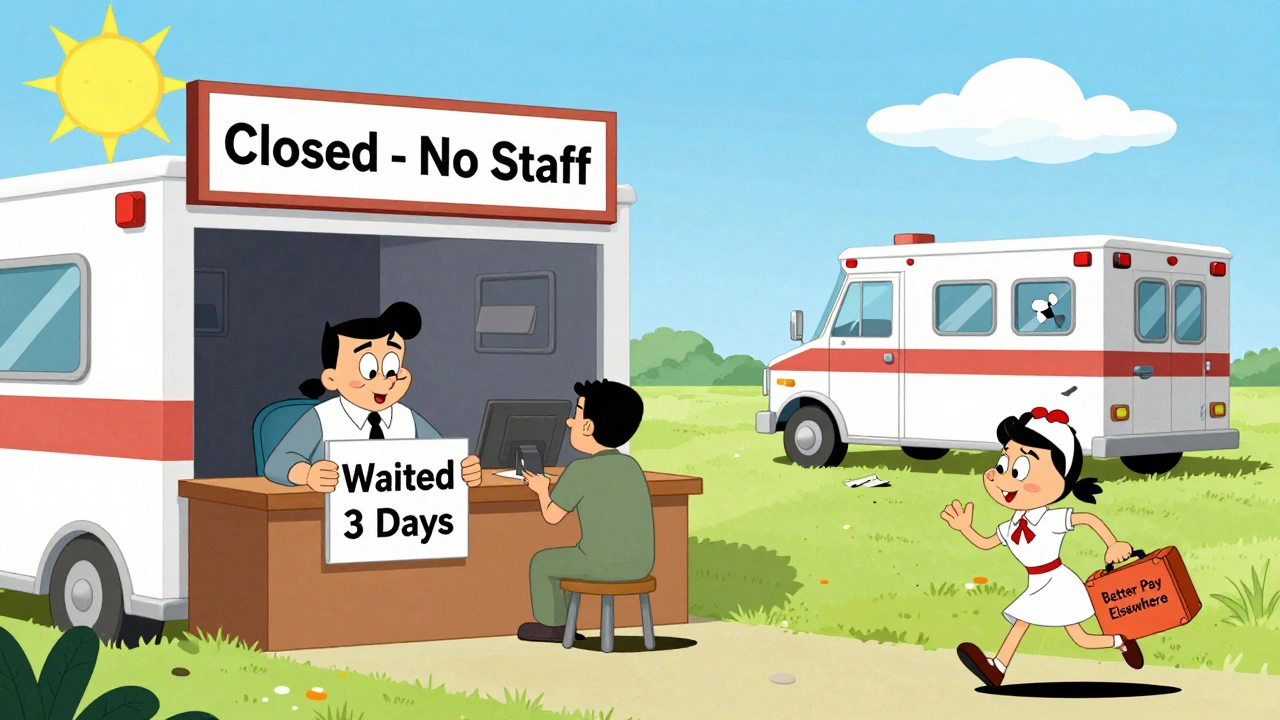
Why the Fixes Aren’t Working
You’ve probably heard about solutions: hire more nurses, pay more, use AI, expand telehealth. But most of these are band-aids. Travel nurses help fill gaps, but they cost hospitals 34% more in labor. That money comes out of other services - physical therapy, social work, even cleaning staff. And when the travel nurse leaves, the problem comes back. Telehealth was supposed to help. Some pilot programs cut ER visits by 19%. But it takes $2.3 million to set up - and 68% of hospitals can’t get their electronic records to talk to each other. Without that, telehealth doesn’t work. Plus, not every patient can use a smartphone. Many seniors can’t. Many low-income families don’t have reliable internet. AI tools for documentation sound promising. But they take 8.7 weeks to learn. That’s 32 hours of training per nurse - time they don’t have. And if the system doesn’t work right, it adds more work, not less. States like California and Massachusetts have tried to fix things with laws - minimum nurse-to-patient ratios, loan forgiveness programs. Massachusetts cut its shortage to 8% below the national average. But most states haven’t followed. Federal funding for nursing education? $247 million a year. Experts say it needs to be $1.2 billion. That’s a gap of nearly $1 billion.What’s Really at Stake
This isn’t just about hospitals being busy. It’s about the future of care. By 2050, there will be 82 million Americans over 65. That’s nearly double the number in 2023. Each of those people will need more care - more visits, more medications, more monitoring. But the working-age population supporting them is shrinking. Right now, there are four workers for every senior. In five years, it’ll be less than three. And many of those workers are already quitting. McKinsey says closing the global healthcare worker shortage could prevent 189 million years of life lost to early death and disability. That’s not just a statistic - it’s mothers who don’t die from preventable infections. It’s grandparents who don’t get sepsis because no one checked their wound. It’s kids who get their asthma under control before they end up in the ICU. The cost of inaction is staggering. Hospitals are losing $4.2 million a month just from closed beds. Insurance companies pay more for emergency care than they do for preventive care. And families? They pay in stress, grief, and lost time.
Is There Any Hope?
Yes - but only if we stop treating this like a staffing problem and start treating it like a system failure. Some hospitals are making real progress. The Mayo Clinic spent 18 months redesigning care teams. They cut nurse turnover by 31%. How? They gave nurses more control over their schedules. They reduced paperwork with better tech. They paid for mental health support. It cost $4.7 million - but it saved money in the long run. We need more of that. We need funding for nursing schools that actually works. We need states to adopt safe staffing laws. We need to stop treating nurses like replaceable parts and start treating them like the backbone of care. Technology can help - but only if it’s designed for the people using it, not the people selling it. AI shouldn’t replace nurses. It should free them up to be nurses - to talk to patients, to catch warning signs, to hold a hand when it’s needed most. The crisis won’t fix itself. It’s getting worse. But it’s not inevitable. What we do in the next five years will determine whether hospitals can still function - or whether they become places people avoid because they’re too broken to trust.What You Can Do
If you’re a patient, speak up. Tell your doctor if you’ve waited too long. Report unsafe conditions. Ask if your hospital has a staffing plan. If you’re a student, consider healthcare. There’s never been a better time to become a nurse, a technician, a therapist. The need is real. The pay is better than most people think. And the work matters. If you’re a policymaker, fund education. Pass safe staffing laws. Support rural clinics. Don’t wait for the next crisis to hit - it’s already here. This isn’t about politics. It’s about people. And if we don’t fix this, more people will die - not because of illness, but because no one was there to help them.Why are hospitals closing beds due to staffing shortages?
Hospitals close beds because they don’t have enough nurses, aides, or technicians to safely care for patients. Even if a bed is available, a hospital can’t legally or ethically assign care without the staff to monitor vital signs, give medications, respond to emergencies, or assist with daily needs. Closing beds is a last resort to prevent unsafe conditions.
Are travel nurses making the shortage worse?
Travel nurses fill urgent gaps, but they don’t solve the root problem. They cost hospitals far more than permanent staff - up to 34% higher labor costs - which pushes budgets away from training, retention, and infrastructure. Their temporary presence can also create resentment among permanent staff who feel overworked and underpaid. They’re a stopgap, not a solution.
How does the nurse shortage affect rural clinics?
Rural clinics face 37% higher vacancy rates than urban ones. Many have shut down entirely. Those that remain operate at just 58% staffing. Patients travel hours for basic care, screenings are delayed, chronic conditions go unmanaged, and emergencies often require ambulance transfers to distant hospitals - if one is even available.
What’s being done to train more nurses?
Some states are expanding loan forgiveness and offering signing bonuses. The federal government recently allocated $500 million for nursing education - but experts say $1.2 billion is needed annually. Nursing schools are turning away over 2,300 qualified applicants each year because they lack faculty, classrooms, and clinical placements.
Can AI fix the healthcare staffing crisis?
AI can help reduce administrative tasks like documentation and scheduling, freeing up nurses to focus on patients. But it can’t replace human judgment, empathy, or hands-on care. Most hospitals struggle to implement AI due to outdated systems, poor training, and resistance from staff. AI is a tool - not a cure.
What’s the link between staffing and patient safety?
Studies show that when nurse-to-patient ratios exceed 1:4, patient mortality increases by 7%. Medication errors, missed vital signs, delayed responses to deterioration, and hospital-acquired infections all rise with understaffing. Safe staffing isn’t a luxury - it’s the foundation of patient survival.