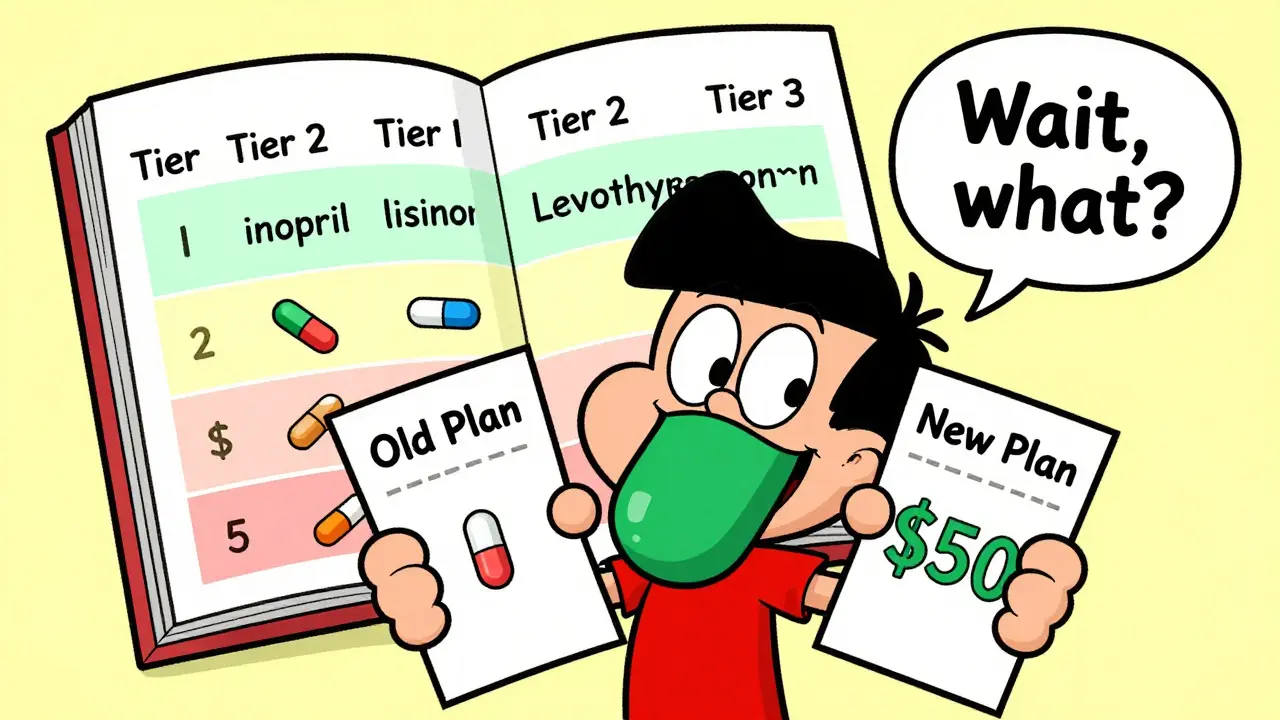
When you switch health plans, your monthly premium might drop-but your prescription bills could spike. It’s not about the plan you pick, it’s about whether your generic drugs are still covered at a price you can afford. Thousands of people make this mistake every year: they choose a cheaper plan, only to find out their metformin, lisinopril, or levothyroxine suddenly costs $50 instead of $5. That’s not a surprise-it’s a failure to check the formulary.
What Is a Formulary, and Why Does It Matter?
A formulary is the list of drugs your insurance covers. It’s not just a catalog. It’s broken into tiers, and each tier has a different price. Tier 1 is almost always generic drugs. That’s where you want to be. Tier 2 might be brand-name drugs or less common generics. Tier 3 and 4? Those are specialty or high-cost meds. And if your drug isn’t on the list at all? You pay full price. In 2023, 84% of all prescriptions filled were for generic drugs. But they made up only 14% of total drug spending. Why? Because generics work the same as brand names but cost a fraction. If your plan puts your generic on Tier 1, you could pay $3 to $20 per month. If it moves it to Tier 2? That could jump to $40 or more. And if your plan has a deductible? You might pay $1,000 out of pocket before your $5 copay even kicks in.Tier Structures: 3, 4, or 5? It Changes Everything
Not all plans are built the same. The most common structures are:- 3-tier plans: Usually found in employer plans. Generic copays are $5-$10. Simple. Predictable.
- 4-tier plans: Standard on the Health Insurance Marketplace. Tier 1 = generics ($3-$20). Tier 2 = preferred brand-name drugs. Tier 3 = non-preferred brands. Tier 4 = specialty drugs. This is where things get messy.
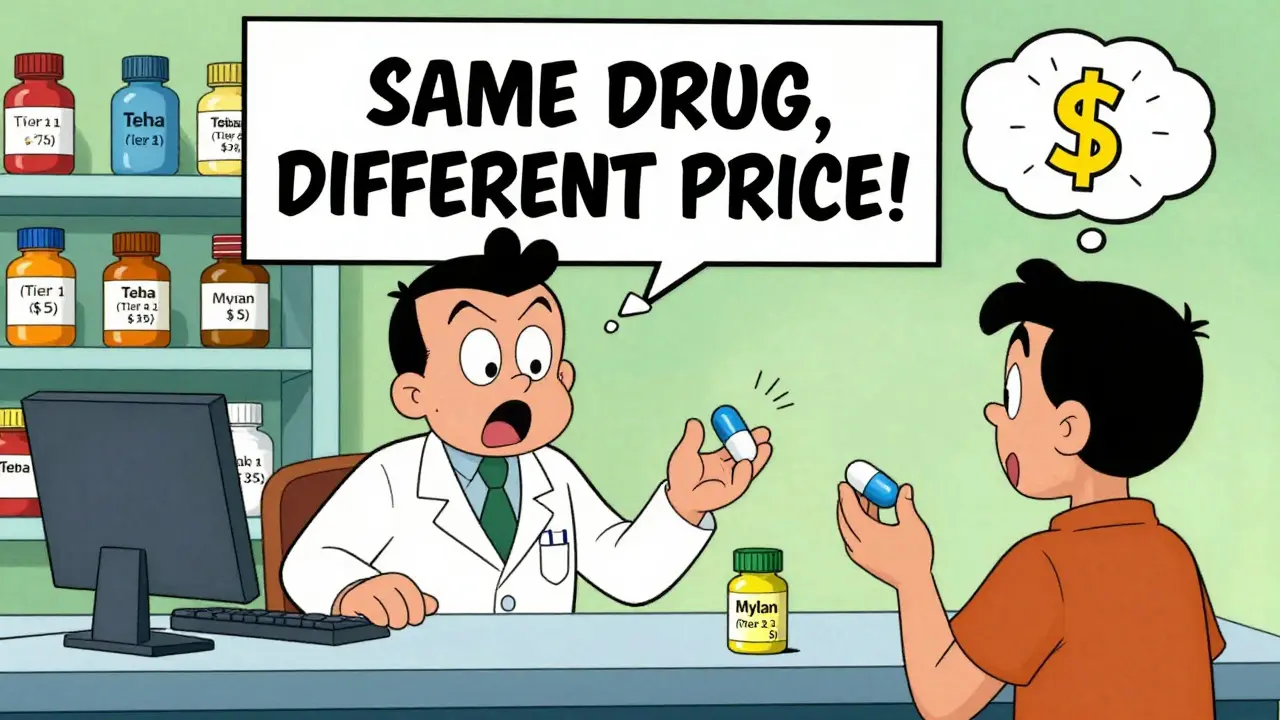
- 5-tier plans: Common in Medicare Advantage. Now generics are split: Tier 1 = preferred generics ($0-$10), Tier 2 = non-preferred generics ($20-$40). Same drug, different price, depending on the manufacturer.
Medicare vs. Marketplace vs. Employer Plans
Your plan type changes how you pay.Medicare Part D: In 2023, the base deductible was $505. But most plans waive that for Tier 1 generics. You pay $0-$10 per script. Some plans even have $0 copays for generics. But if you switch plans mid-year, your new plan might not cover your current generic at all. About 15% of Medicare beneficiaries hit this wall every year.
Marketplace plans (ACA): Silver plans with Special Design (SPD) are the best for generic users. They waive your deductible for Tier 1 drugs. So even if your deductible is $3,000, your $10 generic copay starts on Day 1. Non-SPD plans? You pay the full deductible before your copay applies. For someone on three generics, that’s $1,500-$5,000 extra per year.
Employer plans: These vary wildly. Some charge $5 generics before the deductible. Others require you to hit the deductible first. MHBP Federal Health Plans, for example, offer a Basic Option with $5 generics pre-deductible and a Consumer Option with $10 generics post-deductible. The difference? $120 a year if you take one generic. Multiply that by three meds. That’s $360. Just for a plan switch.
State Rules Can Make or Break Your Costs
Where you live changes everything.- In New York, generic drugs have $0 deductible and a $75 copay for specialty drugs-but generics? Often $0 or $5.
- In California, you pay an $85 outpatient drug deductible first. Then 20% coinsurance, capped at $250 per year. That’s not a copay. That’s a percentage. So if your drug costs $100, you pay $20. If it costs $200, you pay $40. No cap on per-script cost.
- In Washington, D.C., there’s a separate $350 drug deductible. Generics are covered after that, but you still pay $150 for specialty drugs.
What to Check Before You Switch
Don’t guess. Don’t assume. Don’t rely on the plan’s summary. Here’s your checklist:- Get the full formulary. Not the brochure. Not the website summary. Download the complete drug list from the insurer’s website. Look for your exact drug name.
- Check the manufacturer. Your metformin might be made by Teva. The new plan might only cover Mylan. Same active ingredient. Different tier. Different price.
- Verify the strength. Is your dose 500mg? 1000mg? Some plans cover only one strength. If yours isn’t listed, you’re out of luck.
- Check your pharmacy. Your local CVS might be in-network. But if you use a mail-order pharmacy, your copay could be 300% higher. OptumRx found 40% of people pay way more because they don’t know their plan only covers certain pharmacies.
- Calculate your annual cost. Multiply your monthly copay by 12. Add your deductible if it applies. Then compare it to your current plan. Don’t just look at premiums.
Tools That Actually Help
Use these tools. Don’t skip them.- Medicare Plan Finder (medicare.gov/plan-compare): Type in your drugs. It shows you exactly what you’ll pay under every plan. Used by over 4 million people in 2022.
- Healthcare.gov plan selector: Filters plans by your medications. Shows tier info and copays.
- Insurer-specific formulary tools: Most big insurers (UnitedHealthcare, Blue Cross, Aetna) have their own search tools. Accuracy? Up to 96% if you use the official one.
- eHealthInsurance’s calculator: Processes 1.7 million queries a month. Enter your drugs, your zip code, your deductible. It compares all plans.
The Biggest Mistakes People Make
Most people don’t fail because they’re careless. They fail because they don’t know what to look for.- “My drug’s covered.” But is it the same brand? Same strength? Same pharmacy? If any of those change, your cost changes.
- “I don’t take many meds.” Even one drug can cost $500 a year if you’re on the wrong tier or have a high deductible.
- “I’ll just pay cash.” Sometimes the cash price at Walmart is $4. But if your plan covers it, you pay less. Always compare.
- “I’ll switch after open enrollment.” Outside open enrollment, you can’t switch unless you qualify for a special enrollment period. Miss it? You’re stuck until next year.
What’s Changing in 2025?
The rules are shifting.- The Inflation Reduction Act caps insulin at $35/month-starting in 2023, but now it’s standard.
- By 2025, Medicare Part D will have a $2,000 annual out-of-pocket cap for all drugs. That’s huge.
- Medicare’s 2025 formulary will split generics into Tier 1 (preferred) and Tier 1+ (non-preferred). That’s new. You’ll need to check again.
- More states are banning integrated deductibles. California’s $85 drug deductible? That’s a model. By 2027, most marketplace plans will likely follow.
Final Advice: Don’t Switch Blind
You wouldn’t buy a car without checking the fuel economy. Why switch a health plan without checking your drug coverage? The cheapest premium isn’t the cheapest plan. The plan with the lowest copay for your meds is. And if you’re on three or four generics? That’s your most important cost. Take 30 minutes. Download the formulary. Type in your drugs. Compare the numbers. Talk to your pharmacist. Call the insurer. Ask: “If I switch, will my metformin cost the same?” Do that, and you won’t be one of the 15% of people who get blindsided by a $500 drug bill after switching plans.How do I know if my generic drug is covered by a new health plan?
Download the full formulary from the insurer’s website-not just the summary. Search for your exact drug name and manufacturer. If it’s listed, check which tier it’s on. Tier 1 means lowest cost. If it’s not listed, it’s not covered. Some plans only cover specific brands or strengths, so check the dose too.
Why does my generic drug cost more on one plan than another, even though it’s the same medicine?
Because insurers group generics into preferred and non-preferred based on the manufacturer, not the active ingredient. Two versions of metformin-same chemical, different company-are treated as different drugs. One might be Tier 1 ($5), the other Tier 2 ($35). Always check the manufacturer listed on your prescription.
Do all health plans have the same drug tiers?
No. Marketplace plans usually have 4 tiers. Medicare Part D plans often have 5. Some employer plans have only 3. Medicare Advantage plans may separate generics into two tiers (Tier 1 and Tier 1+). Always check the specific structure of the plan you’re considering.
What’s the difference between a deductible and a copay for generics?
A deductible is the amount you pay before your insurance starts helping. A copay is a fixed fee you pay at the pharmacy. Some plans make you pay your full medical deductible before your generic copay kicks in. Others, like Silver SPD plans, waive the deductible for generics-you pay just the $20 copay from day one. That can save you thousands.
Can I switch health plans anytime I want?
No. You can only switch during Open Enrollment (usually November to December) or if you have a qualifying life event-like moving, losing other coverage, or getting married. If you switch at the wrong time, you’ll be stuck with your current plan until next year-even if your meds get more expensive.
Are there tools to compare drug costs between plans?
Yes. Medicare.gov’s Plan Finder and Healthcare.gov’s plan selector let you enter your drugs and see exact costs. Insurer websites also have formulary tools. eHealthInsurance’s calculator is used by over a million people monthly. These tools are accurate and free. Use them.
What should I do if my generic drug is no longer covered after switching plans?
First, ask your doctor if there’s an alternative generic on the new plan’s formulary. If not, you can file an exception request with your insurer. Some plans will cover your drug if you prove it’s medically necessary. You can also pay cash-sometimes the cash price is lower than your copay. Always compare.