Side Effect Onset Calculator
How Soon Do Side Effects Appear?
Enter your medication details to see if your symptoms align with typical onset patterns.
Your Timing Analysis
Based on your medication class and symptom timeline:
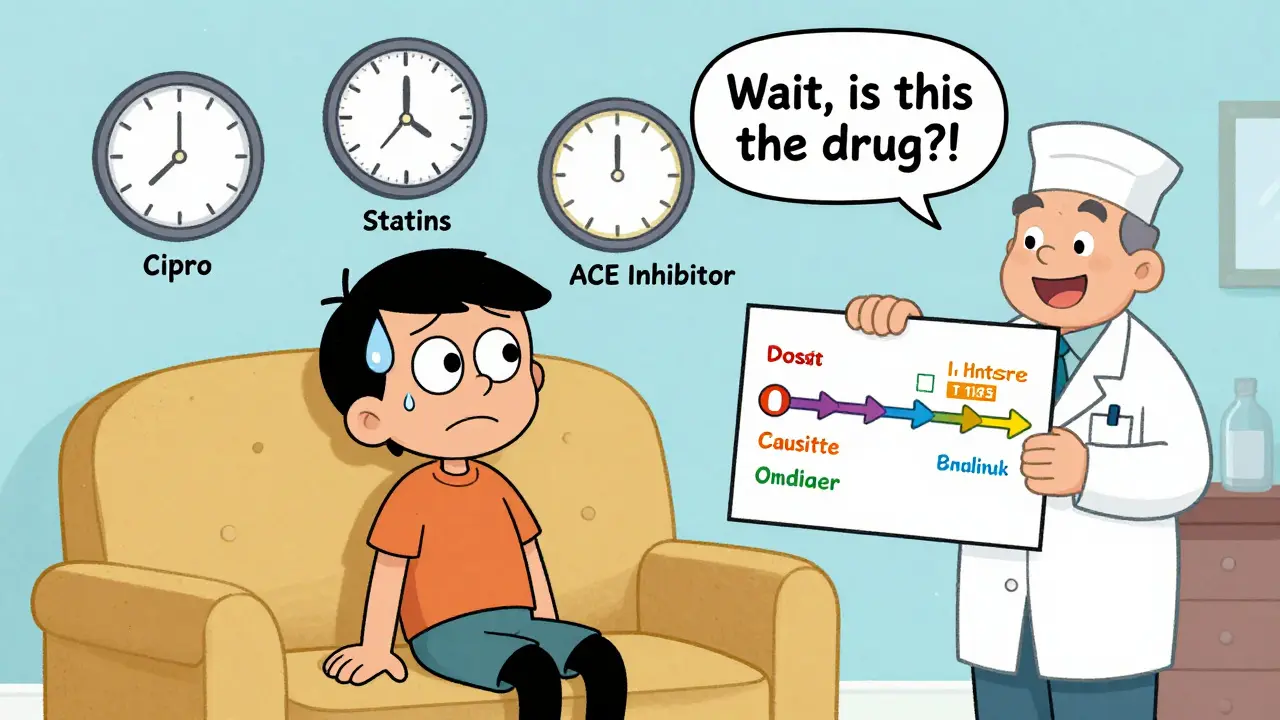
Have you ever started a new medication and felt weird a few days later? Maybe your muscles ached after taking a statin, or your face swelled up weeks after beginning an ACE inhibitor. You might have thought, "Is this the drug, or just bad luck?" The truth is, time-to-onset-when side effects actually show up-follows predictable patterns based on the drug class. Knowing these patterns can help you, your doctor, and pharmacists spot real problems faster and avoid unnecessary panic.
Why Timing Matters More Than You Think
Not all side effects happen the same way. Some show up within hours. Others creep in over months. If your doctor doesn’t know the typical timing, they might blame your symptoms on something else-like stress, aging, or your original condition. That’s dangerous. A 2025 study in Frontiers in Pharmacology tracked over 1.2 million adverse reactions and found that 78% of them started early-within the first few days or weeks. But that still leaves 22% that appear much later. Missing those can mean misdiagnosis, delayed treatment, or even hospitalization.Fast Onset: Hours to Days
Some drugs hit hard and fast. The clearest examples? Allergic reactions and certain antibiotics.Angioedema from ACE inhibitors (like lisinopril or enalapril) is a classic case. Most people think it happens right after the first dose. But it doesn’t always. Histamine-mediated swelling (true allergy) shows up in minutes to hours. But bradykinin-mediated swelling-more common with ACE inhibitors-can wait. It might not appear until the first week… or even six months later. One patient in a Drugs.com review wrote: "I got severe swelling four months in. My doctor didn’t connect it until I showed him the research." That’s not rare. In fact, delayed cases like this make up nearly 40% of all ACE inhibitor angioedema reports.
Ciprofloxacin, a common antibiotic, is another fast actor. Research shows its most common side effect-peripheral nerve pain (tingling, burning)-hits at a median of 2 days. Women experience it even faster than men: 2 days versus 4 days. That’s not a coincidence. It’s tied to how the body processes the drug. If you start cipro and feel odd tingling in your hands or feet by day 3, don’t wait. Call your doctor. It’s likely the drug, not a virus.
Then there’s acetaminophen (Tylenol) overdose. Unlike most side effects, this one is a direct chemical burn to the liver. It doesn’t wait. Symptoms like nausea and fatigue can begin within 24 hours. If you took more than recommended, even once, and feel off the next day-get checked. This isn’t "maybe"-it’s urgent.
Weeks to Months: The Hidden Window
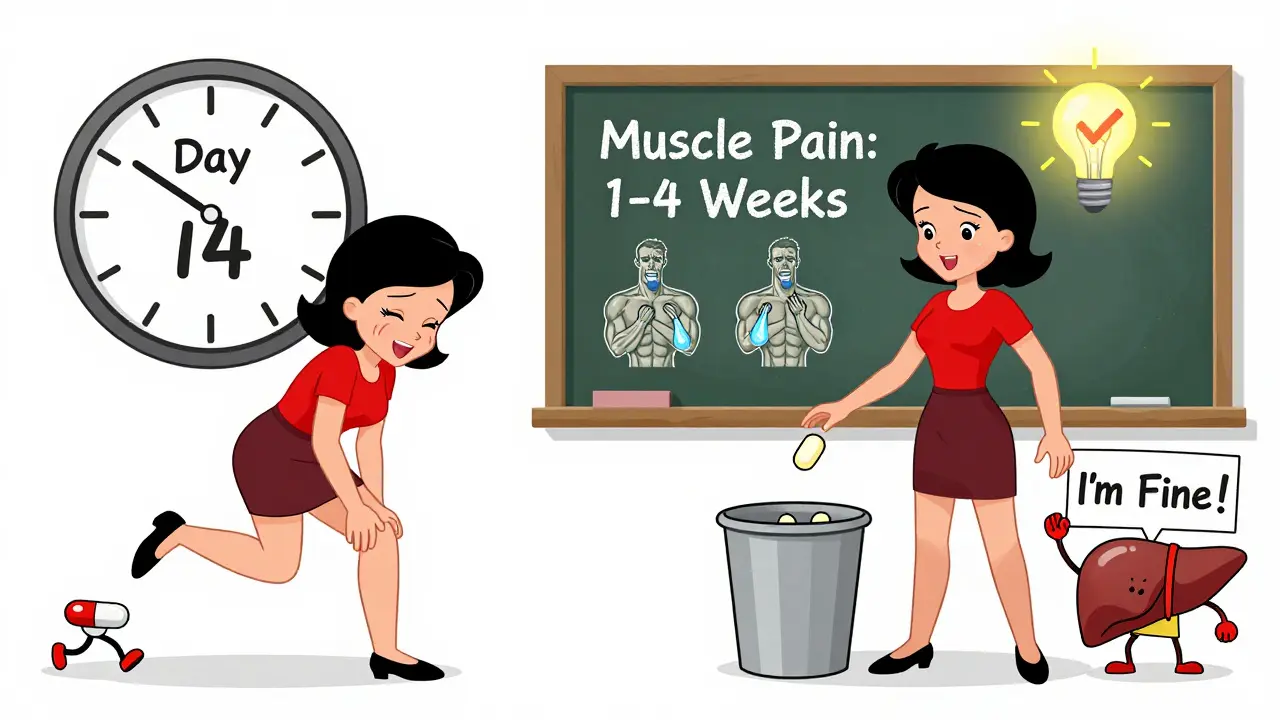
Many side effects hide in plain sight because they don’t show up until you’ve been on the drug for weeks-or longer.Statins (atorvastatin, simvastatin) are the poster child for this. Most people assume muscle pain starts right away. But the data says otherwise. In a major 2021 JACC study, patients reported muscle pain starting between 1 and 4 weeks. And here’s the twist: in a crossover trial with 60 people who had quit statins due to side effects, 55% felt better within 3 days of stopping-whether they were on the real drug or a placebo. That suggests a big chunk of "statin intolerance" is psychological. Still, if pain starts after two weeks, it’s worth investigating.
Pregabalin and gabapentin (used for nerve pain and seizures) show up slower. Dizziness and fatigue? Most patients report it within the first week. But the median time to onset is 19 days for pregabalin and 31 days for gabapentin. That means if you’ve been on it for 3 weeks and suddenly feel foggy, it’s probably the drug-not laziness.
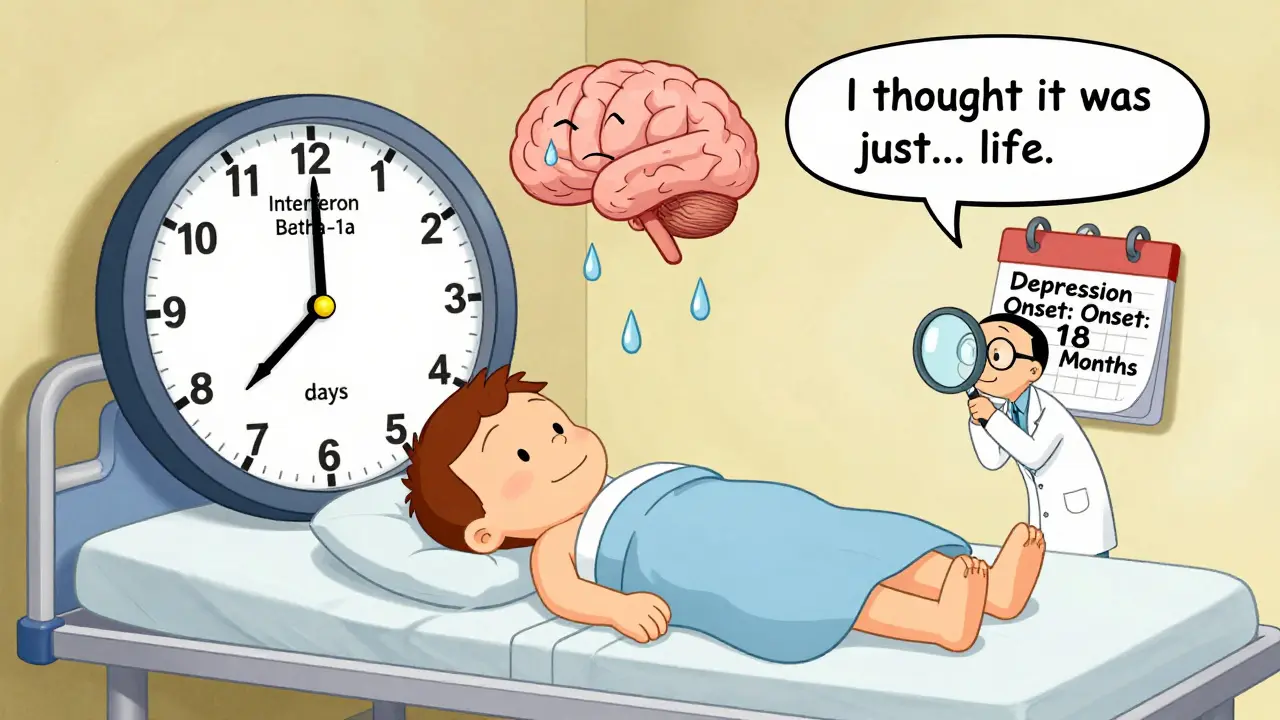
Interferon beta-1a (used for multiple sclerosis) has one of the longest delays. Side effects like flu-like symptoms or depression can take 526.5 days-almost 18 months-to appear. That’s not a typo. It’s because the drug slowly changes immune activity over time. If a patient gets depressed 16 months into treatment, doctors often miss the link. But the pattern is clear: it’s not random.
Idiosyncratic Reactions: The Wild Cards
Some side effects don’t follow any pattern. They’re unpredictable. These are called idiosyncratic reactions. The most common? Drug-induced liver injury.Drug-induced hepatitis from medications like antibiotics, antifungals, or even some supplements, usually shows up around 42 days after starting. But the range? 20 to 117 days. That’s a wide window. If you’ve been on amoxicillin for six weeks and suddenly feel tired, yellow, or have dark urine-get your liver checked. It’s not "just a cold."
Even common drugs like acetaminophen can cause this. Too much? Liver damage in 24 hours. Just a little too much over time? Liver injury after 30 days. The difference? Dose and duration. This is why taking "just one extra" painkiller every day for months can be riskier than one big overdose.
How Clinicians Use This Data
Hospitals aren’t just guessing anymore. Electronic health records now have built-in tools that flag side effects based on timing. Mayo Clinic rolled out a system in January 2022 that uses time-to-onset algorithms. Result? A 22% increase in correctly identified drug reactions.Regulators are catching up too. Since 2020, the European Medicines Agency requires all new drug applications to include time-to-onset modeling using something called the Weibull distribution. It’s a math model that predicts risk patterns: early, late, or steady. Most drugs (78%) have a pattern where risk drops after the first few days. But some, like interferon, have a slow build-up. That’s why labeling now says things like: "Side effects may appear up to 6 months after starting."
Pharmaceutical companies are building machine learning tools to predict timing based on a drug’s chemical structure. By 2025, 41 of the top 50 drugmakers have teams working on this. Why? Because predicting side effect timing saves lives-and billions in lawsuits.
What You Can Do
You don’t need to be a doctor to use this knowledge. Here’s how:- Keep a symptom journal. Note when you started the drug and when you first felt off. Even "I felt tired on day 14" helps.
- Know your drug class. Is it an antibiotic? A statin? An antidepressant? Each has its own clock.
- Ask: "When do side effects usually start?" When your doctor prescribes something, ask for the typical timing. Most don’t know-but they’ll appreciate you asking.
- Don’t ignore late symptoms. If you feel weird 3 months in, it’s not "too late" to be the drug. It might be exactly on time.
And if you’ve been told your symptoms are "just anxiety" or "normal aging"-dig deeper. The data says otherwise.
What’s Coming Next
The future is personal. The NIH’s All of Us program plans to start using genetic data in 2025 to predict not just if you’ll get a side effect-but exactly when. Are you slow to metabolize certain drugs? That could mean your side effects show up 10 days later than average. Wearables are being tested too: imagine your smartwatch detecting early signs of liver stress from a drug before you even feel it.For now, the message is simple: timing isn’t random. It’s science. And knowing when side effects typically appear can turn guesswork into clear action.
How soon do side effects usually start after taking a new medication?
It depends on the drug class. Most side effects appear within the first few days or weeks. About 78% of adverse reactions happen early-within the first 30 days. But some, like those from interferon or ACE inhibitors, can take months. For example, ciprofloxacin causes nerve tingling in about 2 days, while pregabalin might take 19 days. Always check the typical time-to-onset for your specific medication.
Can a side effect start months after I begin taking a drug?
Yes. While many side effects show up quickly, some are delayed. ACE inhibitors can cause angioedema up to 6 months after starting. Interferon beta-1a may trigger depression after nearly a year. Drug-induced liver injury can appear between 20 and 117 days. If you feel unusual symptoms months into treatment, don’t assume it’s unrelated. It might be exactly on schedule.
Do statins really cause muscle pain, or is it all in my head?
Both. Research shows that about half of people who think they have statin-induced muscle pain feel better within 3 days of stopping-even if they’re on a placebo. That points to a strong nocebo effect. But real muscle pain from statins does happen, usually between 1 and 4 weeks after starting. If pain is severe, persistent, or worsens with activity, get it checked. Don’t assume it’s all psychological.
Why do women experience side effects faster than men with some drugs?
Differences in body weight, metabolism, and hormone levels affect how drugs are processed. For example, women metabolize ciprofloxacin faster than men, leading to higher concentrations in nerves sooner. That’s why ciprofloxacin-induced nerve pain hits women at 2 days versus 4 days in men. This isn’t rare-it’s common across many drugs. Sex-based differences are now part of official pharmacovigilance guidelines.
What should I do if I think a medication is causing my symptoms?
Don’t stop suddenly unless it’s an emergency (like swelling or trouble breathing). Instead, write down: when you started the drug, when symptoms began, what they feel like, and if anything makes them better or worse. Bring this to your doctor. If possible, check if the timing matches known patterns for that drug. Many side effects are reversible if caught early. The key is connecting the dots between timing and the drug-not just the symptom.