
You pick up your prescription vial. The label says "Dispense as Written." You trust it. But what if that medicine has been sitting in a plastic bottle with a loose cap, exposed to humidity and light, long past its safe window? Or worse, what if your weekly pill organizer mixes two drugs that react badly when stored together?
This isn't just a hypothetical worry. It is a growing gap in patient safety. When pharmacies transfer drugs from their original manufacturer packaging into smaller vials or combine them into daily pillboxes, the protective barrier designed by the drug maker is broken. This process, known as repackaging, changes how the drug degrades. Without proper evaluation, patients might be taking medications that have lost potency or developed harmful degradation products.
Why does repackaging affect medication stability?
Original manufacturer containers are engineered with specific barrier properties against moisture, oxygen, and light. Repackaged containers often lack these protections, leading to faster degradation through hydrolysis, oxidation, or physical changes like caking.
The Problem with Original Expiration Dates
Most people assume the expiration date on a box applies forever. That assumption fails the moment the drug leaves its original container. According to the U.S. Pharmacopeia Chapter <1178>, which defines pharmaceutical dosage forms, repackaging is the transfer of a drug product from its original container into a different one. This action compromises the container-closure system.
The FDA’s guidance document Q1A(R2) states that drug products must maintain quality, safety, and efficacy throughout their shelf life. However, those guidelines primarily address the manufacturer's original packaging. Once a pharmacist breaks the seal of a bulk bottle and pours tablets into a standard prescription vial, the environment changes. Standard pharmacy vials often have higher moisture vapor transmission rates-around 0.35-0.50 g/m²/day-compared to the manufacturer’s high-density polyethylene (HDPE) bottles with desiccants, which rate closer to 0.10-0.25 g/m²/day.
Consider albuterol sulfate tablets. A study in the Journal of Pharmaceutical Sciences (2019) found that when stored in standard pharmacy vials at 25°C/60% RH, these tablets showed 15.7% degradation after just 90 days. In their original HDPE bottles with desiccant, degradation was only 3.2%. That difference can mean the difference between effective asthma relief and a useless dose.
Key Factors Influencing Degradation
To evaluate stability, you need to understand what kills the drug. Three main enemies attack repackaged medications:
- Moisture: Leads to hydrolysis, breaking down chemical bonds. This is critical for hygroscopic drugs like amoxicillin.
- Oxygen: Causes oxidation, altering the molecular structure. Common in vitamins and certain cardiac drugs.
- Light: Triggers photodegradation. Drugs like nifedipine turn brown and lose potency quickly if not stored in amber containers.
The European Directorate for the Quality of Medicines (EDQM) Technical Report 31 (2020) emphasizes that repackaged medications require specific focus on container-closure integrity. They recommend testing using helium leak detection or dye ingress methods to verify protection. For most community pharmacies, this level of testing is impossible, which is why conservative expiration dating becomes essential.
Evaluating Pillbox Medications: The Interaction Risk
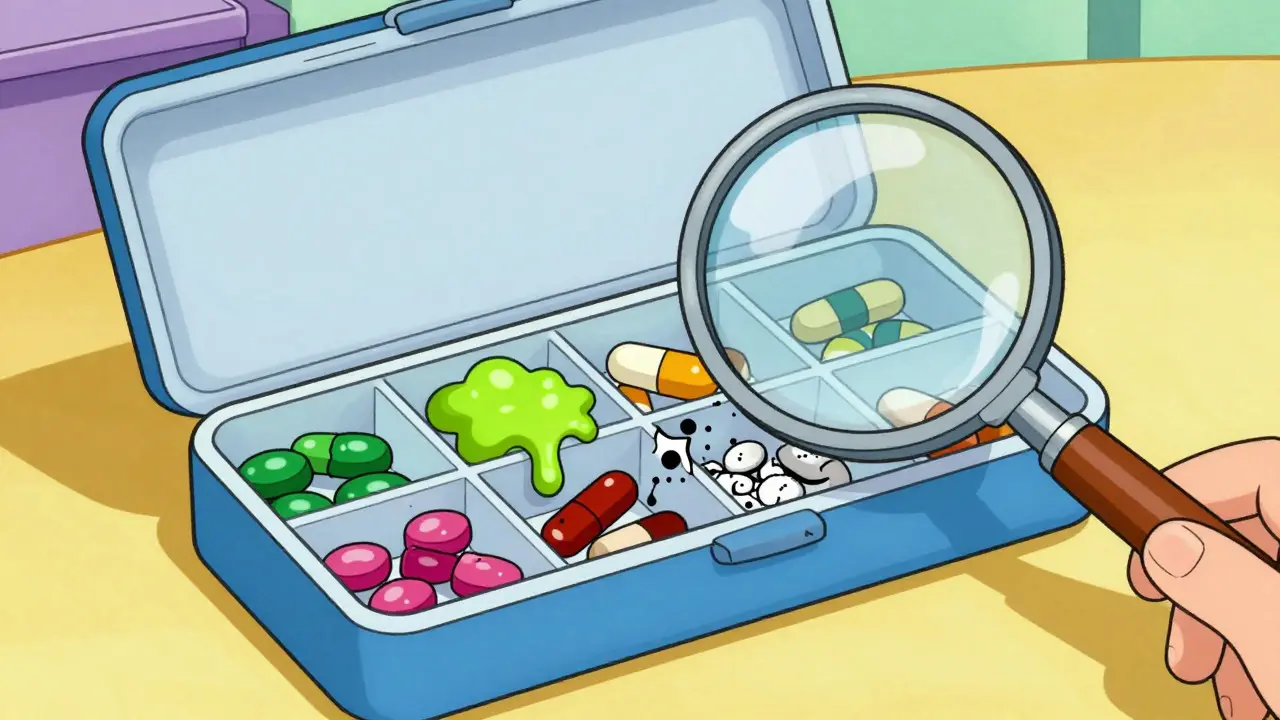
Pillboxes add another layer of complexity. Here, multiple drugs from different manufacturers are combined into a single compartment. This creates potential for direct physical interactions that never occur in separate bottles.
Data from the American Pharmacists Association (2022) shows that when multiple medications are combined in a single organizer, 18.7% exhibit physical interactions within just 14 days. These interactions include caking, color changes, or crumbling. If Drug A absorbs moisture released by Drug B, both may degrade faster than expected.
Because original stability studies rarely test drugs together, pharmacists cannot rely on standard expiration dates for pillboxes. Each combination requires individualized assessment. The Institute for Safe Medication Practices (ISMP) noted in a 2020 alert that 32% of community pharmacies lacked formal stability protocols for these scenarios, leaving patients vulnerable.
Practical Steps for Pharmacies and Patients
So, how do we actually evaluate stability in real-world settings? Formal stability studies following ICH Q1E guidelines require testing three batches over time, which is resource-intensive. However, practical protocols exist.
- Stress Testing: The University of Michigan College of Pharmacy recommends initial stress testing at 40°C/75% RH for 14 days to identify susceptible products before full assessment.
- Analytical Methods: High-performance liquid chromatography (HPLC) is the gold standard. A 2021 study showed reversed-phase HPLC with UV detection could detect degradation products at concentrations as low as 0.05%.
- Conservative Dating: If testing isn't possible, use conservative limits. The Parenteral Drug Association suggests 30 days for hygroscopic drugs, 60 days for light-sensitive ones, and 90 days for stable drugs like atenolol.
For patients, the advice is simple but crucial: ask your pharmacist about the repackaging process. If you receive a pillbox, check for signs of physical change-stickiness, discoloration, or unusual odors. Report any issues immediately.
Regulatory Landscape and Future Standards
The regulatory framework is tightening. The FDA issued a warning letter in 2023 to a major pharmacy chain for failing to establish written procedures for assigning expiration dates to repackaged drugs, resulting in a 45-day shutdown. This signals that regulators are watching closely.
Furthermore, the National Association of Boards of Pharmacy (NABP) survey found that 82% of states limit repackaged medication expiration dates to no more than 6 months, with 34% imposing stricter 30-90 day limits for sensitive classes. The USP is expected to finalize General Chapter <1790> on Repackaged Drug Product Stability, which will standardize testing protocols, including minimum sample sizes and timepoints.
Despite these advances, a gap remains. A 2023 survey revealed that 63% of independent pharmacies lack resources for formal stability testing. Until broader access to analytical tools like HPLC is available, reliance on evidence-based databases, such as the University of Florida’s Web-based Stability Database, is critical. This database provides expiration dating for over 1,800 repackaged scenarios based on actual testing results.
Conclusion: Prioritizing Patient Safety
Evaluating the stability of repackaged or pillbox medications is not just a technical exercise; it is a patient safety imperative. By understanding the risks of altered packaging, recognizing the signs of degradation, and adhering to conservative expiration standards, both pharmacists and patients can mitigate the dangers of ineffective or harmful drugs. As regulations evolve and technology improves, the goal remains clear: ensure every dose delivered is safe, potent, and reliable.
What is the maximum recommended expiration date for repackaged medications?
Generally, repackaged solid oral dosage forms should not exceed 6 months under standard storage conditions. However, specific drugs may require shorter periods: 30 days for hygroscopic drugs, 60 days for light-sensitive drugs, and 90 days for stable drugs, according to PDA Technical Report No. 73.
Can I use the manufacturer's expiration date for repackaged drugs?
No. The FDA explicitly states that the manufacturer's expiration date applies only if the drug remains in its original container with the original closure system and desiccant. Once repackaged, a new expiration date must be assigned based on stability data or conservative estimates.
How do pillboxes affect drug stability?
Pillboxes can cause physical interactions between different drugs, such as caking or color changes, in up to 18.7% of cases within 14 days. These interactions can accelerate degradation, making individualized stability assessment necessary rather than relying on standard dates.
What are the signs that a repackaged medication has degraded?
Signs include discoloration, unusual odors, crumbling, caking, or stickiness. Physical changes often indicate chemical degradation, meaning the drug may have lost potency or formed harmful byproducts.
Which drugs are most sensitive to repackaging?
Hygroscopic drugs (like amoxicillin), light-sensitive drugs (like nifedipine), and narrow therapeutic index drugs are most sensitive. These require strict control of moisture, light, and temperature, and often have shorter expiration windows when repackaged.




Categories